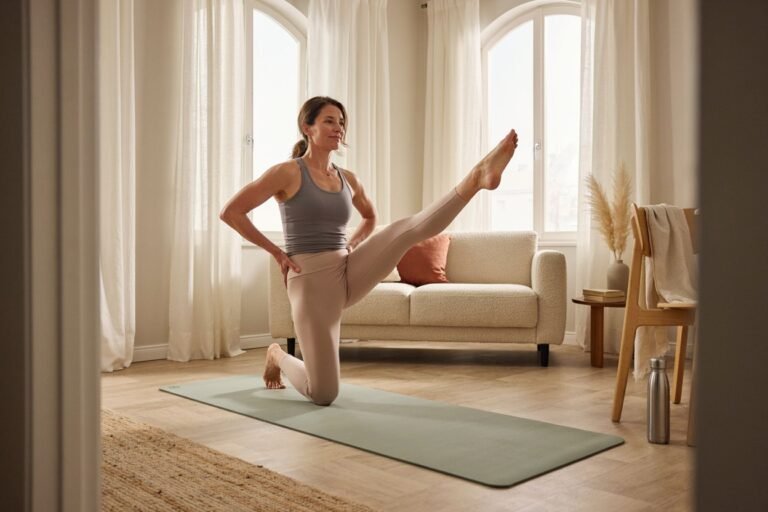
There are plenty of days when getting to the gym simply does not fit into my schedule.
Between work, home responsibilities, family time, and everything else that seems to fill the day, I have learned that waiting for the perfect time to exercise usually means I end up doing nothing.
That is one reason I started paying more attention to simple workouts I could do at home.
What I like most about home workouts is that they do not need to feel complicated.
I can put on comfortable clothes, clear a little space, and get moving without spending time driving somewhere or setting up a long workout.
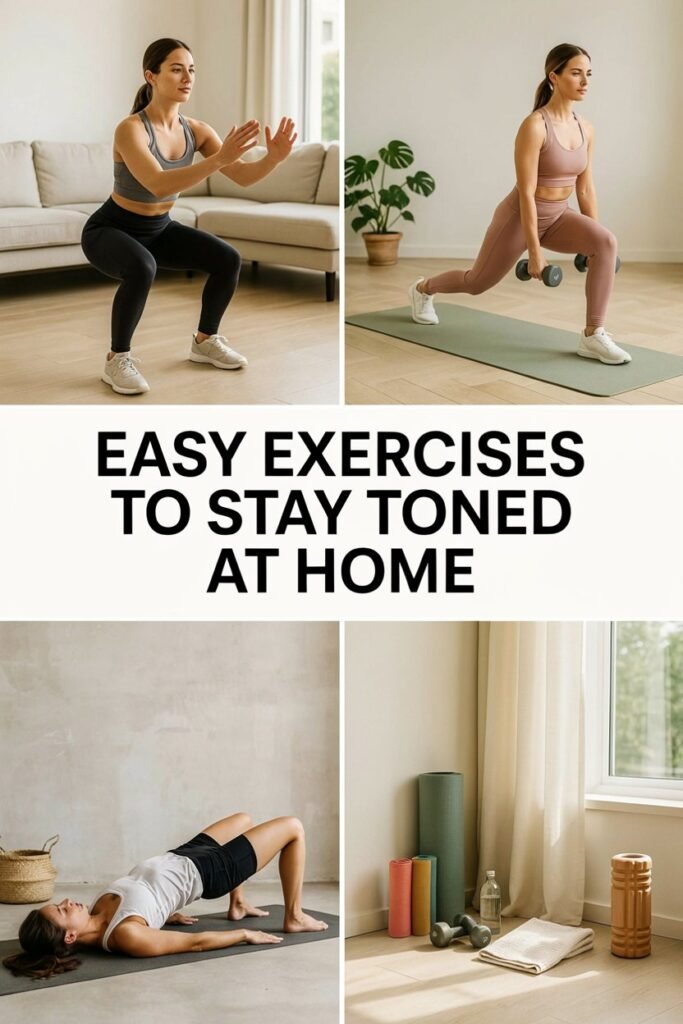
Some days I have only 10 or 15 minutes, while other days I can manage a longer session.
These easy exercises have become a practical way for me to stay active, maintain strength, and feel more toned without making exercise another stressful part of my day.
In this guide, I am sharing the exercises and simple routines that I find easiest to stick with at home.
What Actually Helps You Look Toned?
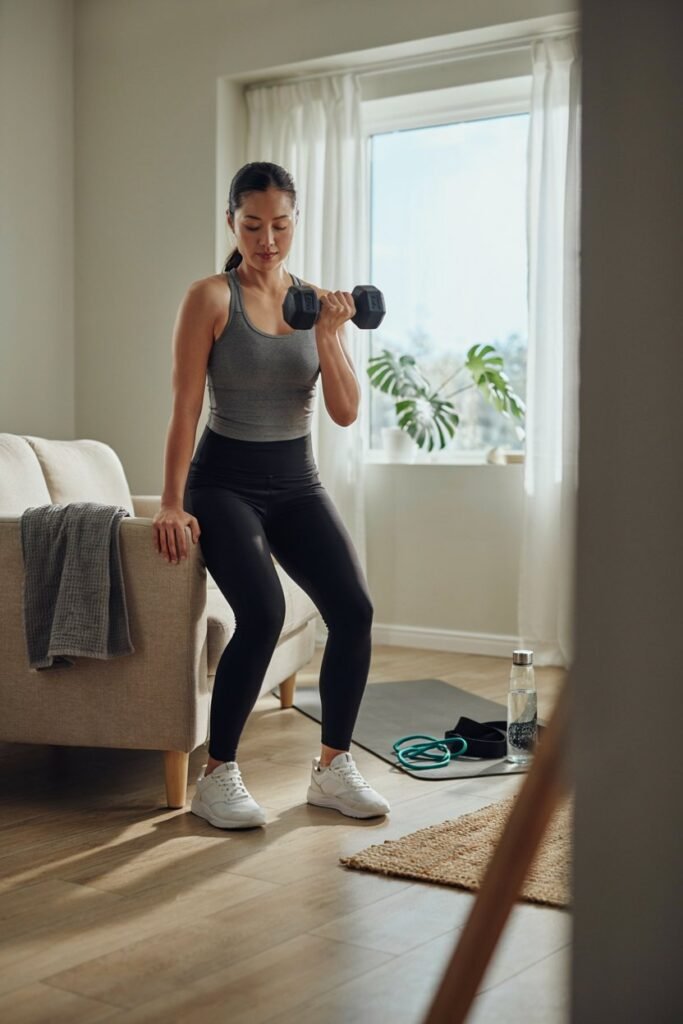
When people talk about wanting to get toned, they usually mean they want their body to look firmer and more defined.
I used to think this required long workouts and a lot of specialized equipment, but I have found that consistency matters much more.
A toned appearance generally comes from maintaining or building muscle while gradually managing overall body fat.
Strength exercises can help with the muscle side of that equation, while regular movement, nutrition, sleep, and your overall activity level all play a role.
You also do not need to train until you are completely exhausted.
For me, a workout that I can realistically repeat several times a week is much more useful than an intense workout that leaves me so tired that I avoid exercising for the next few days.
That is why I prefer simple movements that work several muscle groups and can easily be adjusted as I become stronger.
1. Bodyweight Squats
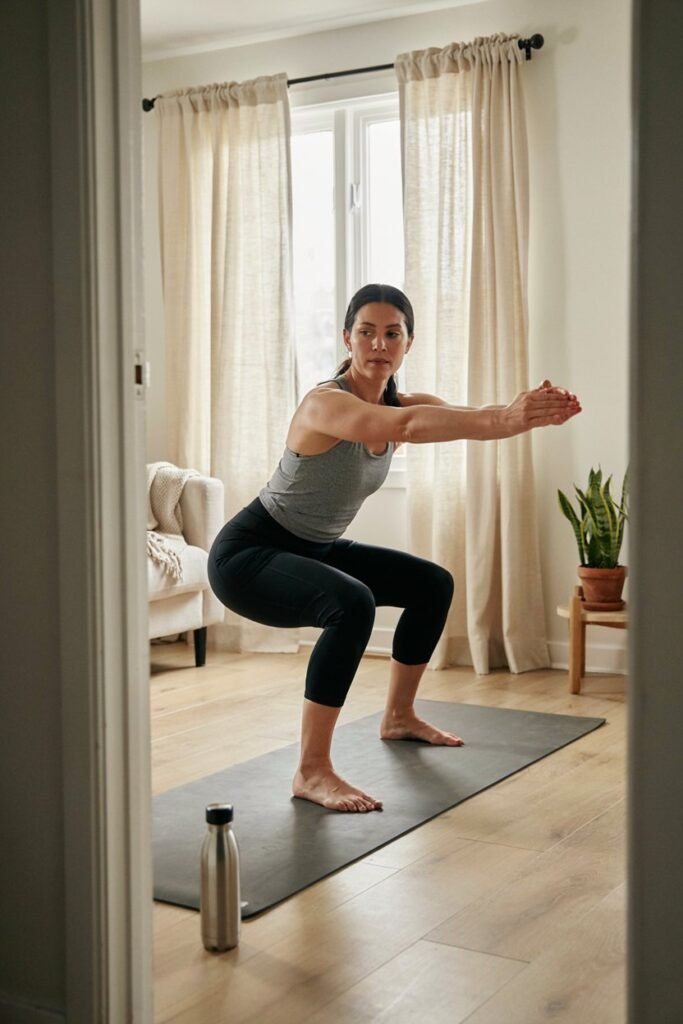
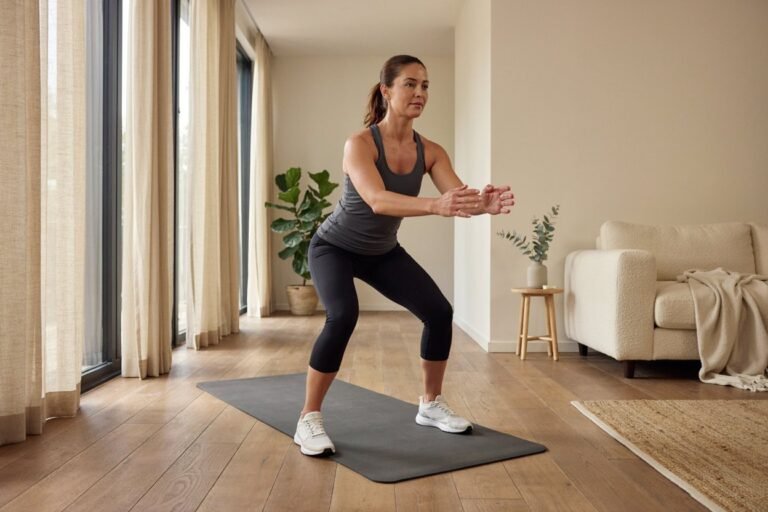
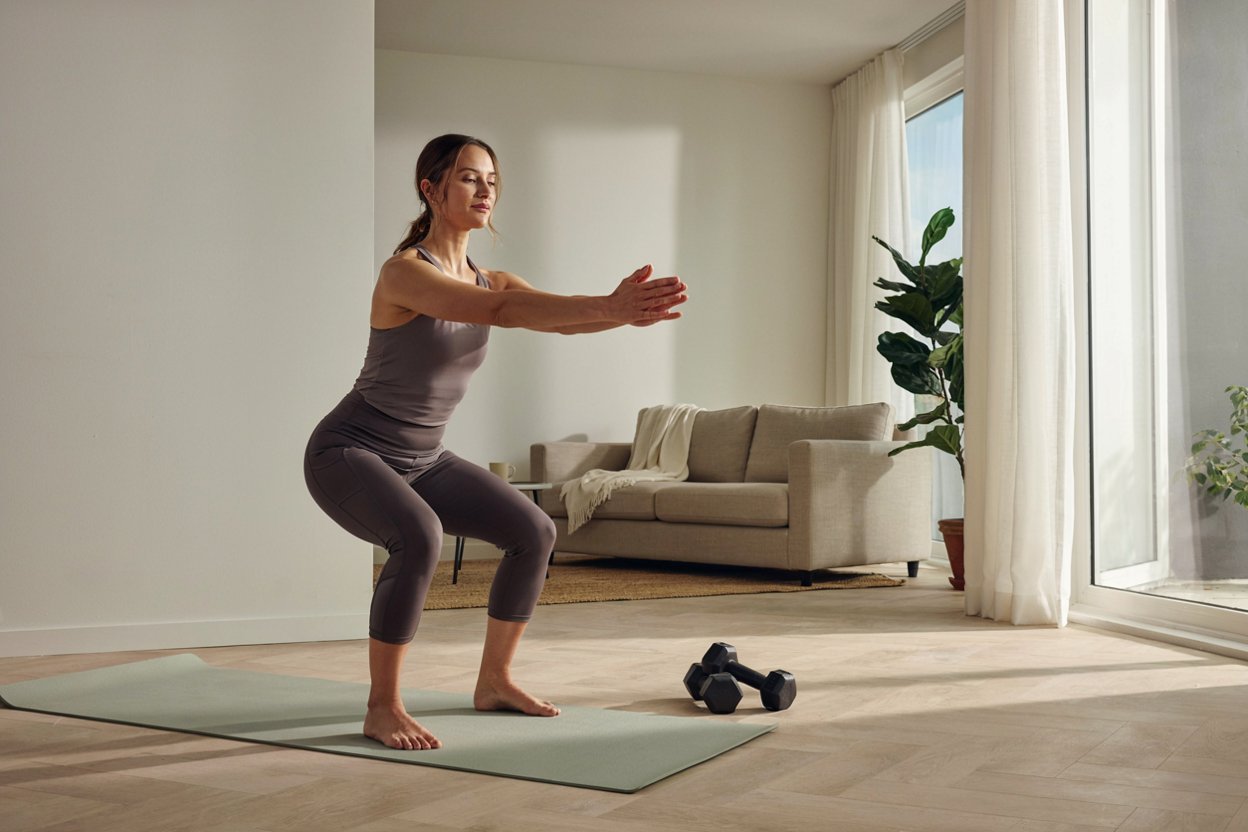
Bodyweight squats are one of the exercises I come back to most often because they require absolutely no equipment and work the lower body well.
They mainly target the quadriceps, hamstrings, and glutes while also requiring your core to help stabilize your body.
How I Do Them
I stand with my feet about hip width apart and keep my chest lifted. From there, I push my hips back and bend my knees as though I am sitting into a chair.
I lower myself as far as feels comfortable while keeping my feet firmly planted. Then I push through my feet and return to standing.
I try not to rush these. Moving slowly and staying controlled makes the exercise feel much more challenging than simply dropping down and standing back up quickly.
Beginner Approach
Start with 8 to 12 repetitions for 2 sets.
If regular squats feel difficult, you can practice sitting down onto a sturdy chair and standing back up.
This gives you more confidence with the movement while still working your legs and glutes.
My Personal Tip
One thing that helped me was focusing less on how many repetitions I could complete and more on performing each repetition properly.
Once the movement became comfortable, I could gradually increase my repetitions or add resistance.
2. Glute Bridges
Glute bridges are another simple movement that I like when I want to focus on my lower body without putting a lot of stress on my knees.
They primarily work the glutes and also involve the hamstrings and core.
How I Do Them
I lie on my back with my knees bent and my feet flat on the floor. My feet stay about hip width apart.
I press through my feet and lift my hips toward the ceiling while squeezing my glutes at the top. I pause briefly before lowering my hips back toward the floor.
The important part for me is keeping the movement controlled instead of using momentum.
How Many Should You Do?
Try 10 to 15 repetitions for 2 or 3 sets.
Once this starts feeling easy, you can hold the top position for a few seconds or progress to a single leg variation if you are comfortable with it.
Why I Like This Exercise
This is one of those exercises I can fit into a workout even when I am not feeling particularly energetic. It does not require much space, and I can easily combine it with squats, lunges, or core exercises for a quick lower body session.
3. Reverse Lunges
Lunges can be surprisingly effective for building lower body strength, but I prefer reverse lunges because I find them easier to control.
They work the glutes, thighs, and hamstrings while also challenging balance.
How I Do Them
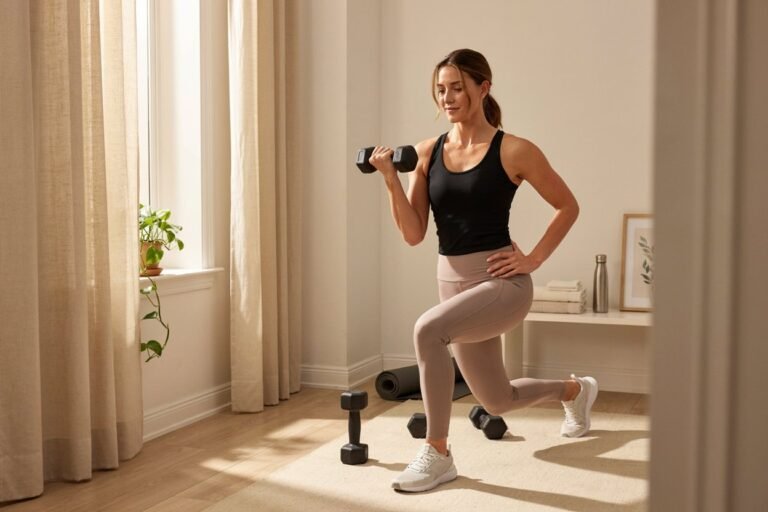
I start by standing tall with my feet together. I step one foot backward and lower my body until both knees are comfortably bent.
I then push through the front foot to return to the starting position before repeating on the other side.
I keep my movements controlled and avoid taking a huge step backward.
Beginner Modification
If balance is an issue, place one hand lightly on a wall or sturdy piece of furniture for support.
You can also start with 6 to 8 repetitions on each side rather than trying to do a large number immediately.
My Personal Tip
I have found that lunges become much easier when I stop worrying about speed.
Taking my time helps me concentrate on keeping my front foot stable and using my leg muscles rather than simply moving through the exercise.
4. Wall Sit
A wall sit looks simple, but holding the position can quickly make your thighs work.
I like this exercise because it gives me another way to challenge my legs without repeatedly moving through squats or lunges.
How I Do It
I stand with my back against a wall and slowly slide down until my knees are bent.
I keep my back against the wall and hold the position for as long as I can comfortably maintain good form.
You do not have to force yourself to reach a perfect 90 degree angle. If that position feels too difficult, stay higher on the wall.
A Good Starting Point
Try holding for 20 to 30 seconds.
Rest for around 30 to 60 seconds and repeat 2 or 3 times.
As your legs become stronger, you can gradually increase the holding time.
5. Standing Side Leg Raises
Standing side leg raises are useful when I want a simple movement that focuses on the outer hips and glutes.
They are also easy to add to a short workout because they do not require getting down onto the floor.
How I Do Them
I stand tall and hold onto a wall or chair if I need extra balance.
I slowly lift one leg out to the side while keeping my upper body as still as possible.
I lower the leg with control and repeat before switching sides.
The movement does not need to be very large.
I find that lifting the leg slowly and avoiding swinging it makes the exercise much more effective.
Try 10 to 15 repetitions on each side for 2 sets.
6. Incline Push Ups
If traditional push ups are difficult, incline push ups are one of the easiest ways to make the movement more approachable.
I like using a sturdy countertop or another stable elevated surface because it reduces some of the resistance while still allowing me to work my chest, shoulders, arms, and core.
How I Do Them
I place my hands on the elevated surface slightly wider than my shoulders and step my feet back.
I keep my body in a straight line and bend my elbows to lower my chest toward the surface.
Then I press through my hands to return to the starting position.
The higher the surface, the easier the movement generally feels. As you become stronger, you can gradually use a lower surface.
My Personal Tip
I would rather do a smaller number of controlled repetitions than rush through a large set with poor form.
Keeping my body stable makes the exercise feel much more challenging.
7. Bird Dogs
Bird dogs are one of my favorite simple core exercises because they do more than just make your stomach muscles work.
They also challenge balance, coordination, and overall stability.
How I Do Them
I start on my hands and knees with my hands underneath my shoulders and my knees underneath my hips.
I slowly extend one arm forward while extending the opposite leg backward.
I pause briefly, return both limbs to the starting position, and then switch sides.
The goal is to keep the rest of your body as still as possible.
Start with 6 to 10 repetitions on each side.
Why I Include Them
I like adding bird dogs toward the beginning of a workout because they help me focus on controlled movement.
They are also a nice change when I do not want every core exercise to involve crunches or long plank holds.
8. Calf Raises
Calf raises are easy to overlook, but they are a simple way to strengthen the lower legs without needing any equipment.
How I Do Them
I stand with my feet about hip width apart and hold onto a wall or chair if needed.
I slowly rise onto the balls of my feet, pause at the top, and lower my heels back toward the floor.
I try to avoid bouncing.
Start with 15 to 20 repetitions for 2 sets.
Once regular calf raises become easy, you can make them more challenging by performing them one leg at a time while holding onto something stable for balance.
A Simple Way to Start
If you are new to home workouts, I would not recommend trying to complete every exercise in this article in one session.
That is something I have learned to appreciate with my own workouts. More exercises do not automatically mean better results.
Instead, choose 4 or 5 movements that cover different areas of your body.
For example, you could combine:
Bodyweight squats
Glute bridges
Incline push ups
Bird dogs
Calf raises
Complete 2 rounds and rest whenever you need to.
The goal is to finish feeling like you challenged your body without feeling completely drained for the rest of the day.
9. Standing Knee Drives
Standing knee drives are an easy way to bring more movement into a home workout without needing much space.
I like using them when I want something that raises my heart rate a little while also making my core work.
I usually keep these controlled rather than trying to move as quickly as possible.
How I Do Them
I stand tall with my feet about hip width apart. I lift one knee toward my chest while bringing my opposite hand toward the knee.
I lower the leg and repeat on the other side.
I keep my stomach gently engaged throughout the movement and try not to lean backward as I lift my knees.
Start with 20 to 30 seconds and rest before repeating for another round.
My Personal Tip
When I am short on time, I use standing knee drives between strength exercises. They help keep me moving without needing to get onto the floor.
10. Dumbbell Romanian Deadlifts
If you have a pair of dumbbells at home, Romanian deadlifts are one of the exercises I would add to a home routine.
They are particularly useful for working the hamstrings and glutes while also teaching you how to use your hips properly during a strength exercise.
How I Do Them
I stand with my feet about hip width apart while holding a dumbbell in each hand.
I keep my back neutral, slightly bend my knees, and push my hips backward.
As my hips move back, I lower the dumbbells along the front of my legs.
I stop when I feel a comfortable stretch through the backs of my legs, then push through my feet and bring my hips forward to return to standing.
The dumbbells do not need to touch the floor.
A Common Mistake
One mistake I try to avoid is turning this into a squat.
The main movement should come from pushing the hips backward rather than bending the knees deeply.
Start with a light weight until the movement feels natural.
Try 8 to 12 repetitions for 2 or 3 sets.
11. Bent Over Rows
Bent over rows are useful when you want to strengthen the upper back and arms at home.
I especially like including pulling exercises because many simple home workouts contain plenty of squats and pressing movements but very little work for the back.
How I Do Them
I hold a pair of dumbbells and slightly bend my knees.
I push my hips backward and lean forward while keeping my back comfortable and neutral.
From there, I pull the dumbbells toward my ribs, keeping my elbows close to my body.
I slowly lower the weights and repeat.
My Personal Tip
I focus on pulling with my back rather than simply moving my hands.
A lighter weight with controlled repetitions usually feels much better to me than using heavy dumbbells and relying on momentum.
Try 8 to 12 repetitions for 2 or 3 sets.
12. Shoulder Presses
Shoulder presses are a simple way to add upper body strength training to a home routine.
They work the shoulders and also involve the arms and core as you stabilize the weights.
How I Do Them
I stand with a dumbbell in each hand and bring the weights up to about shoulder height.
I press them upward until my arms are comfortably extended.
Then I slowly lower the dumbbells back to shoulder height.
I avoid locking my elbows aggressively at the top.
If You Do Not Have Dumbbells
You can use resistance bands if you have them.
If you have no equipment at all, you can focus on other upper body movements such as incline push ups and wall exercises until you have access to resistance.
Start with 8 to 12 repetitions.
13. Side Plank
The side plank is one of those exercises that looks simple but can become challenging quickly.
I like it because it targets the sides of the core while also requiring the body to stay stable.
How I Do It
I lie on my side and place my elbow underneath my shoulder.
I bend my knees for an easier version or extend my legs for a more challenging version.
I lift my hips away from the floor and hold the position while keeping my body as straight as I comfortably can.
Beginner Version
Start with your knees bent and hold for 10 to 20 seconds on each side.
As you become stronger, gradually increase the holding time.
You do not need to hold a plank for several minutes to make it worthwhile.
14. Dead Bugs
Dead bugs have become one of my favorite core exercises because they force me to slow down and actually control my movements.
They are especially useful if you want a core exercise that does not involve repeatedly bending your spine.
How I Do Them
I lie on my back with my arms extended toward the ceiling and my knees bent.
I slowly lower one arm and the opposite leg toward the floor.
I bring them back to the starting position and repeat on the other side.
The key is keeping my lower back from lifting excessively away from the floor.
Start with 6 to 10 controlled repetitions per side.
My Personal Tip
I would rather perform fewer repetitions slowly than rush through this exercise.
If you find yourself losing control, reduce the range of motion.
15. Glute Kickbacks
Glute kickbacks are another simple movement I like using when I want to give my glutes some extra attention.
They do not require equipment, although a resistance band can make them more challenging.
How I Do Them
I start on my hands and knees.
Keeping one knee bent, I slowly lift one leg upward behind me.
I squeeze the glute at the top and then lower the leg with control.
I avoid swinging my leg or arching my lower back.
Try 10 to 15 repetitions per side for 2 sets.
Make It Harder
Once regular kickbacks become easy, you can add a resistance band or slow down the movement.
You can also pause for a few seconds at the top of each repetition.
16. Step Ups
If you have a stable step or low platform that is specifically designed to support your weight, step ups can be a useful lower body exercise.
I like them because they combine strength, balance, and movement in one exercise.
How I Do Them
I place one foot firmly on the step.
I push through that foot and bring the other leg up.
Then I carefully step back down and repeat.
I keep the movement controlled rather than jumping onto the platform.
Safety Matters
Only use a surface that is stable and designed to support you.
If you are unsure whether a chair, table, or household object is safe for stepping, do not use it.
You can replace step ups with reverse lunges or squats if you do not have a suitable platform.
17. Forearm Plank
Planks are a classic core exercise, but I think they are often made harder than necessary.
You do not need to hold a plank for several minutes.
How I Do Them
I place my forearms on the floor with my elbows underneath my shoulders.
I extend my legs behind me and keep my body in a straight line.
I gently tighten my stomach and glutes while breathing normally.
I hold the position for as long as I can maintain good form.
For beginners, even 15 to 20 seconds can be enough.
My Personal Tip
I stop the set when I can no longer maintain good form.
If my hips start dropping toward the floor or rising too high, I know it is time to rest.
Quality matters more than chasing a longer number.
18. Mountain Climbers
Mountain climbers can add a little more intensity to an at home workout.
They work the core while also getting your whole body moving.
How I Do Them
I begin in a high plank position with my hands underneath my shoulders.
I bring one knee toward my chest and then return it to the starting position as I bring the opposite knee forward.
I continue alternating sides.
I do not always perform these quickly. When I am focusing on strength and control, a slower version makes me concentrate more on my core.
Beginner Modification
Place your hands on a sturdy elevated surface and perform the movement from there.
This reduces the amount of weight your upper body has to support.
Try 20 seconds to start, followed by rest.
How I Make These Exercises More Effective
One thing I have learned from home workouts is that simply repeating the exact same routine forever is not the best approach.
Your body adapts.
An exercise that felt challenging when you started may eventually become much easier.
That does not mean the exercise stopped being useful. It means you may need to gradually increase the challenge.
There are several ways I like to do this without making my workouts complicated.
Add More Repetitions
If you started with 8 squats and they now feel easy, try 10 or 12.
You do not need to immediately double the number.
Small increases are easier to maintain.
Add Another Set
If you normally perform 2 sets, adding a third set can increase the total amount of work without changing the exercise itself.
Slow Down
Slowing down the lowering portion of an exercise can make a familiar movement much more challenging.
This works particularly well with squats, lunges, push ups, glute bridges, and rows.
Add Resistance
A pair of dumbbells or resistance bands can give you more options as you become stronger.
You do not need a huge collection of equipment.
Even one or two pieces of basic equipment can make home strength training more versatile.
Reduce Your Rest Slightly
If you are doing a circuit and your goal is to keep moving, you can gradually reduce your rest periods.
I would not make this the main way you progress strength, but it can be useful when you want to make a workout feel more challenging.
A 20 Minute Full Body Home Workout
When I have around 20 minutes available, I prefer keeping the routine simple.
Start with a few minutes of gentle movement to warm up.
Then complete:
Bodyweight squats for 12 repetitions
Incline push ups for 8 to 12 repetitions
Glute bridges for 15 repetitions
Bent over rows for 10 repetitions
Reverse lunges for 8 repetitions on each side
Bird dogs for 8 repetitions on each side
Forearm plank for 20 seconds
Rest for around 30 to 60 seconds before starting the next round.
Complete 2 to 3 rounds depending on your fitness level and how much time you have.
I would rather complete two good rounds than rush through three rounds with poor form.
What I Do When I Only Have 10 Minutes
Not every workout needs to be a full session.
When I only have 10 minutes, I choose five exercises and move through them without overthinking it.
For example:
Squats
Glute bridges
Incline push ups
Standing knee drives
Bird dogs
I perform each movement for around 40 seconds and rest for 20 seconds before moving to the next exercise.
After completing the five exercises, I repeat them once more if I have enough time.
This is one of the simplest ways I have found to stay consistent when the day gets busy.
The biggest lesson for me has been that a short workout is still a workout. I do not need to wait until I have a completely free afternoon before I can take care of my body.
How Often Should You Do These Exercises?
One thing I have learned is that you do not need to work out every day to make progress.
When I first started taking home workouts more seriously, I sometimes thought that doing more sessions would automatically give me better results.
In reality, trying to exercise hard every day made it much harder for me to stay consistent.
I now prefer to think about my workouts across the entire week instead of judging myself based on one day.
For most people, 3 to 4 strength focused workouts each week can be a realistic starting point.
You can fill the other days with walking, gentle movement, stretching, or complete rest depending on how your body feels.
The important thing is to give your muscles enough time to recover.
My Simple Weekly Home Workout Schedule
If you are not sure how to organize these exercises, this is a simple schedule you can start with.
Monday: Full Body Strength
Bodyweight squats
Glute bridges
Incline push ups
Bent over rows
Bird dogs
Forearm plank
Complete 2 to 3 rounds.
Tuesday: Light Movement
I would keep this day easier.
A walk, gentle stretching, household activities, or another form of comfortable movement can be enough.
I actually enjoy these lighter days because they keep me active without making exercise feel like a daily obligation.
Wednesday: Lower Body
Reverse lunges
Bodyweight squats
Glute kickbacks
Standing side leg raises
Calf raises
Wall sit
Complete 2 to 3 rounds.
Thursday: Recovery
Take a rest day or do some gentle stretching.
If your muscles are still very sore, I would not try to push through another hard workout simply because the schedule says you should exercise.
Friday: Full Body
Romanian deadlifts
Shoulder presses
Incline push ups
Glute bridges
Standing knee drives
Dead bugs
Forearm plank
Complete 2 to 3 rounds.
Saturday: Optional Activity
This can be your flexible day.
You could go for a longer walk, do a short home workout, ride a bike, clean the house, spend time outdoors, or simply do something that keeps you moving.
I like having an optional day because life does not always follow a perfect workout schedule.
Sunday: Rest
Give yourself permission to rest.
Rest is not wasted time.
It is part of the process.
Do You Need Equipment to Get Toned at Home?
No.
You can build a very useful beginner home workout using nothing more than your own body weight.
Squats, lunges, glute bridges, push ups, planks, bird dogs, and many other exercises can be performed without equipment.
That said, having a few simple pieces of equipment can give you more options as you become stronger.
A pair of dumbbells can make exercises such as rows, shoulder presses, squats, and Romanian deadlifts more challenging.
Resistance bands can also be useful for glute exercises, rows, presses, and other movements.
You do not need to buy everything at once.
If I were starting again with a small home workout setup, I would focus on a few versatile pieces rather than filling an entire room with equipment.
How Nutrition Supports a Toned Appearance
Exercise is only one part of the picture.
If your goal is to look more defined, your eating habits matter too.
This does not mean you need to follow an extremely restrictive diet.
For me, the biggest difference comes from paying more attention to the quality and balance of my meals rather than trying to eat as little as possible.
I try to include a good source of protein with my meals, along with vegetables, fruit, whole grains, healthy fats, and enough water.
Protein is particularly useful because it supports muscle maintenance and recovery.
Good options can include:
Eggs
Chicken
Fish
Greek yogurt
Cottage cheese
Beans
Lentils
Tofu
Lean meat
You also do not need to completely remove carbohydrates to get results.
Rice, potatoes, oats, whole grain bread, fruit, and other carbohydrate sources can all fit into a balanced eating pattern.
The goal is to build eating habits that you can actually maintain.
Do Not Rely on Spot Reduction
This is something I think is important to mention because it is one of the biggest misconceptions surrounding toning workouts.
You cannot choose exactly where your body loses fat by doing exercises for that particular area.
Doing hundreds of abdominal exercises will strengthen your core, but it does not specifically force your body to remove fat from your stomach.
The same applies to the arms, thighs, hips, or any other area.
Strength training can help develop the muscles underneath, while overall nutrition and activity influence changes in body fat.
Where your body stores and loses fat is also influenced by factors such as genetics and individual physiology.
That is why I prefer focusing on becoming stronger and more consistent rather than obsessing over one specific body area.
Common Home Workout Mistakes to Avoid
Doing Too Much Too Soon
It is tempting to start with a long workout because you are motivated.
The problem is that your body may not be ready for it.
Starting with shorter sessions gives you room to build gradually.
Changing Your Routine Every Few Days
There is nothing wrong with trying new exercises, but constantly changing your workout can make it difficult to know whether you are actually getting stronger.
I prefer keeping the basic movements consistent for a while and gradually making them more challenging.
Ignoring Form
More repetitions do not make an exercise better if you cannot control the movement.
I would rather complete 10 controlled squats than 25 rushed repetitions.
Never Increasing the Challenge
Your body needs a reason to adapt.
Once an exercise becomes very easy, consider adding repetitions, another set, resistance, or a harder variation.
Training Through Pain
There is a difference between normal muscular effort and pain that feels sharp, unusual, or concerning.
Do not force yourself through pain simply because you want to complete the workout.
Stop the exercise and seek appropriate professional advice if you are experiencing persistent or concerning pain.
How Long Does It Take to See Results?
This is one of the questions I see most often, and I think it is important to have realistic expectations.
There is no exact number of days or weeks when everyone will suddenly look toned.
Your results depend on your starting point, training routine, nutrition, sleep, daily activity, genetics, and many other factors.
I think it is much more helpful to look for smaller signs of progress.
Maybe your squats feel easier.
Maybe you can hold a plank longer.
Maybe you are using heavier dumbbells.
Maybe your clothes fit differently.
Maybe you have more energy during the day.
Those changes matter.
Visible changes can take longer, so I try not to judge my progress based entirely on the mirror.
What If You Miss a Workout?
Do not try to punish yourself for it.
This is another lesson I have had to remind myself of.
Missing one workout does not undo the work you have already done.
If something comes up, simply continue with your next planned workout.
You do not need to exercise twice as long the following day to make up for it.
A realistic routine has to leave room for busy days, travel, family responsibilities, poor sleep, and everything else that happens in normal life.
Consistency does not mean being perfect.
It means returning to your routine.
How to Make Home Workouts Fit Into a Busy Day
If you struggle with finding time to exercise, I recommend lowering the barrier to getting started.
Keep your workout clothes somewhere convenient.
Choose a small area where you can exercise without moving furniture every time.
Have your dumbbells or resistance bands somewhere accessible.
Decide what workout you are doing before you start.
I also find it helpful to have different workout options depending on how much time I have.
If I have 30 minutes, I can do a full workout.
If I have 15 minutes, I can complete a shorter circuit.
If I only have 5 or 10 minutes, I can choose a few movements and get them done.
This approach takes away the idea that a workout only counts if it is long.
My Favorite Way to Keep Home Workouts Interesting
Repeating the same exercises does not have to mean doing the exact same workout every time.
I might use bodyweight exercises during one session and dumbbells during another.
Some days I focus more on my legs and glutes.
Other days I include more upper body and core exercises.
I also like changing the structure.
One workout might be two or three traditional sets, while another might be a circuit where I move from one exercise to the next.
That small amount of variety helps me stay interested without completely changing the exercises I know work well for me.
Frequently Asked Questions
Can I get toned by exercising at home?
Yes, home workouts can help you build and maintain muscle and improve your overall fitness.
You do not need a gym to perform effective strength exercises.
Your results will also depend on nutrition, daily activity, recovery, and consistency.
How many days a week should I exercise at home?
Three to four strength focused sessions per week can be a practical starting point for many people. You can include walking or other light activities on the days between workouts.
Are bodyweight exercises enough?
They can be, especially when you are beginning.
As you become stronger, you may eventually want to increase the challenge through more repetitions, harder variations, slower movements, or additional resistance.
Can I tone my stomach with home exercises?
Core exercises can strengthen your abdominal muscles, but they cannot specifically remove fat from your stomach.
Overall body composition is influenced by your total activity, nutrition, genetics, and other factors.
Do I need dumbbells?
No. Many effective exercises can be done using only your body weight. Dumbbells are useful because they give you additional ways to progressively increase resistance as you become stronger.
Is a 10 minute workout worth doing?
Absolutely.
A 10 minute workout is better than skipping movement because you believe you do not have enough time for a longer session.
Short workouts can also make it easier to build the habit of exercising consistently.
Should I exercise every day?
You can stay active every day, but that does not mean every day needs to be a hard workout.
Strength workouts should be balanced with easier movement and recovery days.
Final Thoughts
Staying toned at home does not have to mean spending hours exercising or buying expensive equipment.
For me, the biggest advantage of home workouts is how easy they are to fit into real life.
I can choose a short routine when the day is busy or spend more time exercising when I have the opportunity.
The exercises themselves are simple, but that is exactly what makes them useful.
Squats, lunges, glute bridges, push ups, rows, planks, and other basic movements can create a strong foundation when you perform them consistently and gradually increase the challenge.
I also try not to make fitness more complicated than it needs to be. Some days I have a great workout, and other days I only manage a short session. Both are still part of staying active.
If you are starting from scratch, begin with a few exercises you feel comfortable doing.
Give yourself time to improve, pay attention to how your body feels, and focus on becoming stronger rather than expecting overnight changes.
The goal is not to create the perfect home workout.
It is to create a routine that fits your life well enough that you actually want to keep doing it.