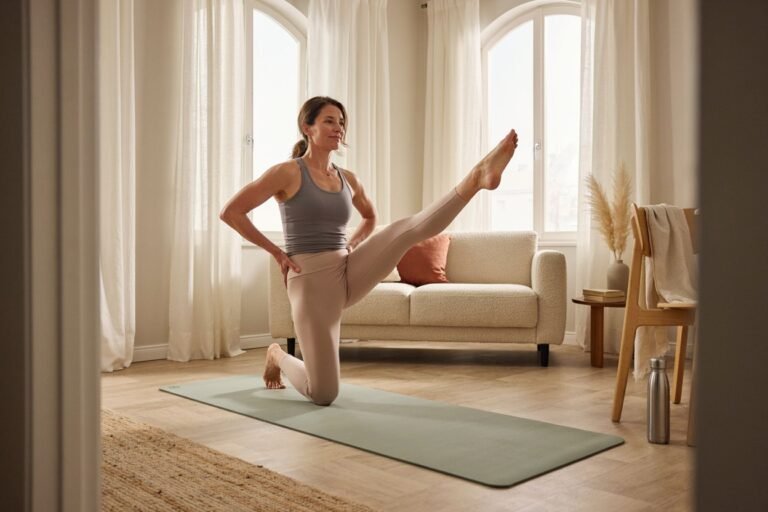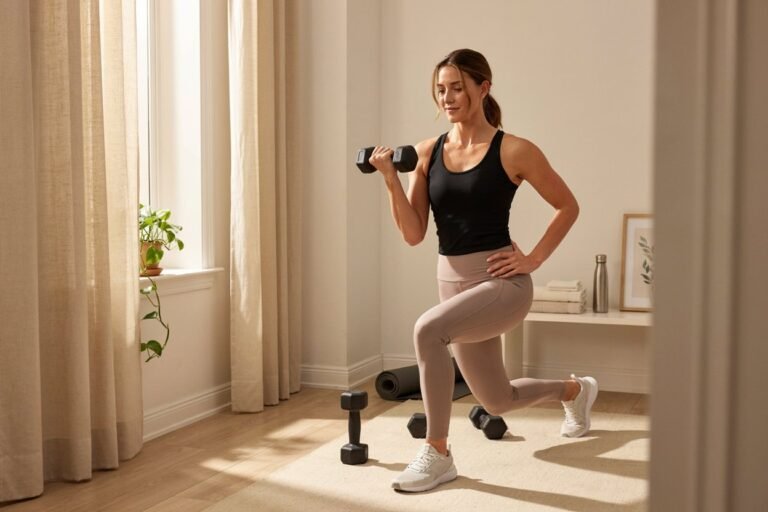
Leg workouts do not have to involve heavy weights, complicated equipment, or a trip to the gym. Some of the exercises I use most often at home are simple bodyweight movements that can be adjusted depending on how much time I have and how challenging I want the workout to feel.
I especially like home leg workouts because they are easy to fit into a normal day. I can exercise in a small space without having to prepare a whole gym bag or spend extra time traveling somewhere.
Even when I only have a short amount of time available, I can choose a few exercises and still give my lower body a useful workout.
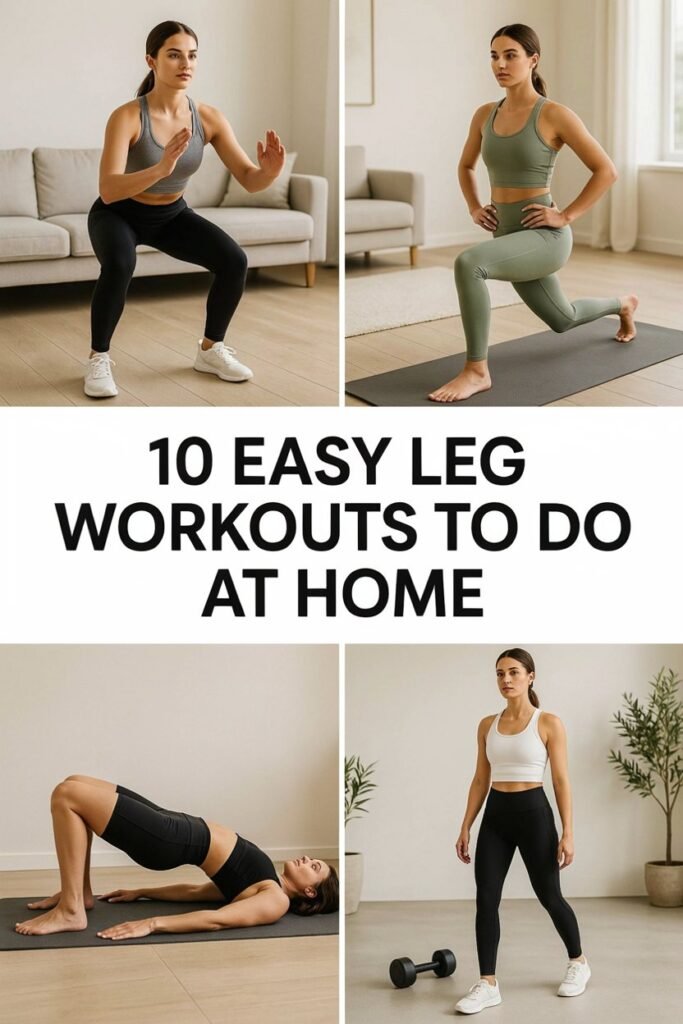
When I put together a leg routine, I like to include exercises that work different parts of the lower body. Squats are useful for the thighs and glutes, bridges help me focus more on the glutes and back of the legs, while lunges add a balance and single leg challenge.
I have also learned that doing more repetitions is not always the answer. Paying attention to your form, slowing down the movement, and using a comfortable range of motion can make basic exercises much more challenging.
These are 10 easy leg workouts you can do at home with little or no equipment. I am starting with three of my go to movements and will cover the remaining exercises in the next parts.
How I Prepare for a Home Leg Workout
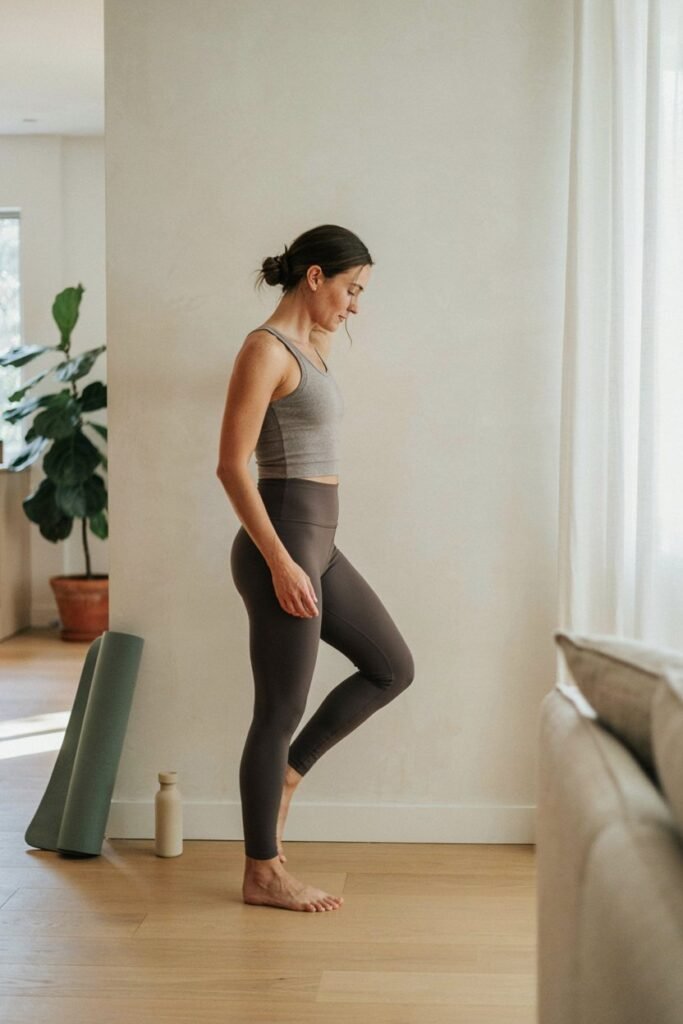
Before I start exercising, I like to spend a few minutes getting my body moving. I do not make my warmup complicated because the goal is simply to prepare my legs for the exercises.
I usually spend a few minutes walking around, moving my legs gently, and doing a few slow bodyweight squats.
A simple warmup can include:
• Walking around the room for two to three minutes
• Gentle leg swings while holding onto a stable surface
• A few slow bodyweight squats
• Gentle hip movements
• Several alternating reverse lunges without going deeply into the movement
I find that starting slowly also helps me pay attention to how my legs feel that day. If something feels uncomfortable before I even begin the workout, I would rather modify the exercise than force myself through it.
1. Bodyweight Squats
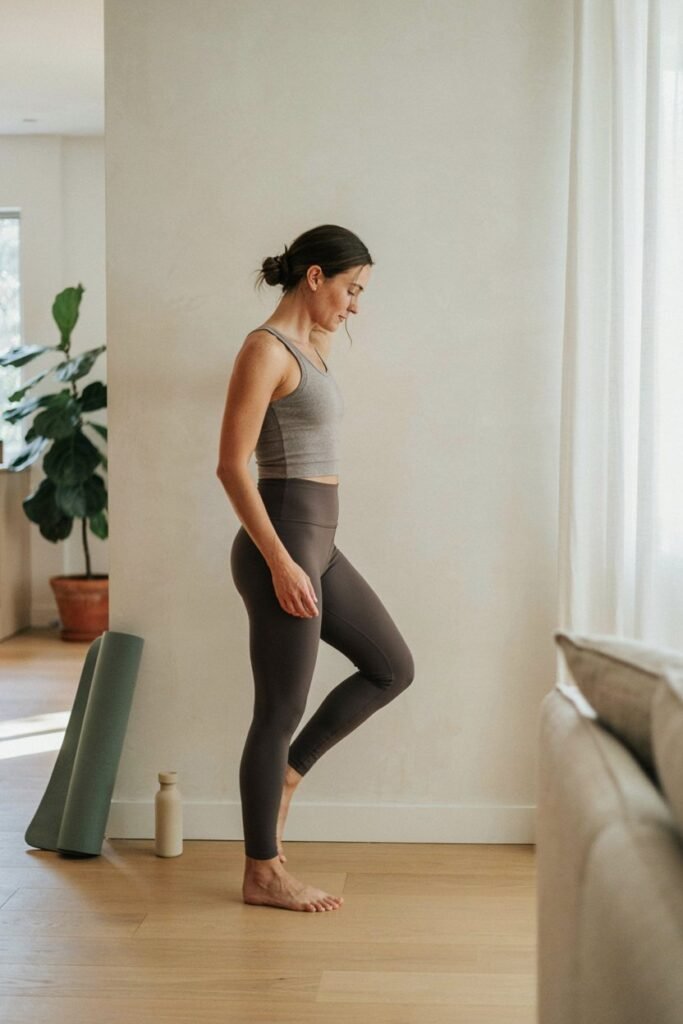
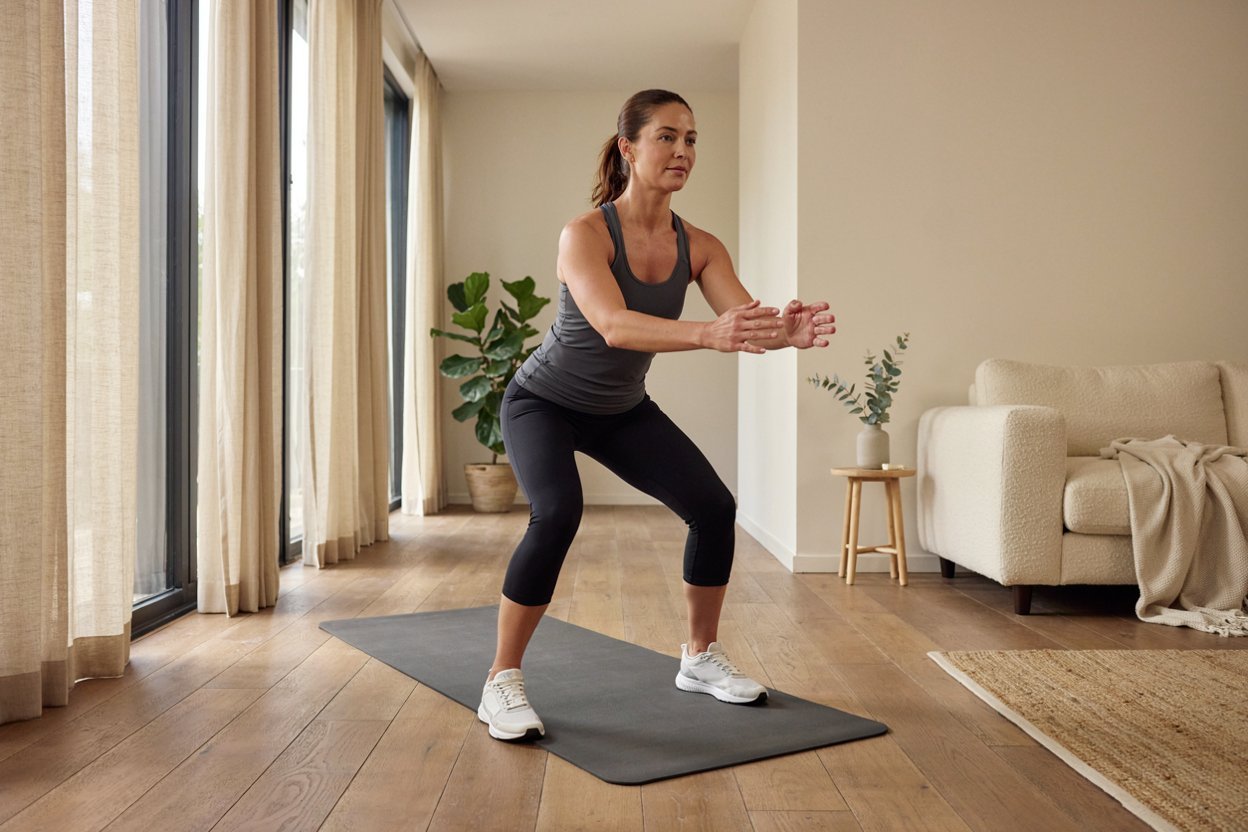
Bodyweight squats are one of the easiest exercises to include in a home leg workout, and they are also one of the movements I return to most often.
They work several muscles at the same time, including the quadriceps, glutes, and hamstrings. They also require you to stabilize your body as you lower and raise yourself.
What I like most about squats is how easy they are to progress. You can start with a shallow range of motion and gradually work deeper as your strength and comfort improve.
What Bodyweight Squats Work
• Quadriceps
• Glutes
• Hamstrings
• Core muscles that help stabilize your body
How to Do a Bodyweight Squat
- Stand with your feet approximately shoulder width apart.
- Keep your toes facing forward or slightly outward, whichever feels natural and comfortable.
- Keep your chest lifted and your shoulders relaxed.
- Brace your stomach gently as you prepare to move.
- Push your hips backward as though you are about to sit into a chair.
- Bend your knees and slowly lower your body.
- Keep your feet flat on the floor as you lower.
- Stop at a depth that feels comfortable while maintaining control.
- Press through your feet and straighten your legs to return to standing.
- Squeeze your glutes gently as you reach the top without leaning backward.
How Many Should You Do?
If you are a beginner, I recommend starting with:
• 8 to 12 repetitions
• 2 sets
• Around 45 to 60 seconds of rest between sets
If that feels comfortable after several workouts, you can gradually work toward 12 to 15 repetitions or add another set.
My Squat Tip
I used to think making the squat deeper automatically made it better. I have found that controlling the movement is much more important.
Try lowering yourself for about two seconds rather than dropping quickly. Then stand up smoothly.
That small change can make bodyweight squats feel considerably harder without adding any equipment.
Common Squat Mistakes
Try to avoid:
• Allowing your knees to collapse inward
• Lifting your heels from the floor
• Rushing through every repetition
• Bending forward excessively
• Going deeper than you can comfortably control
If your balance is an issue, you can place a sturdy chair behind you and practice sitting back toward it without completely relaxing your weight onto the chair.
2. Glute Bridges
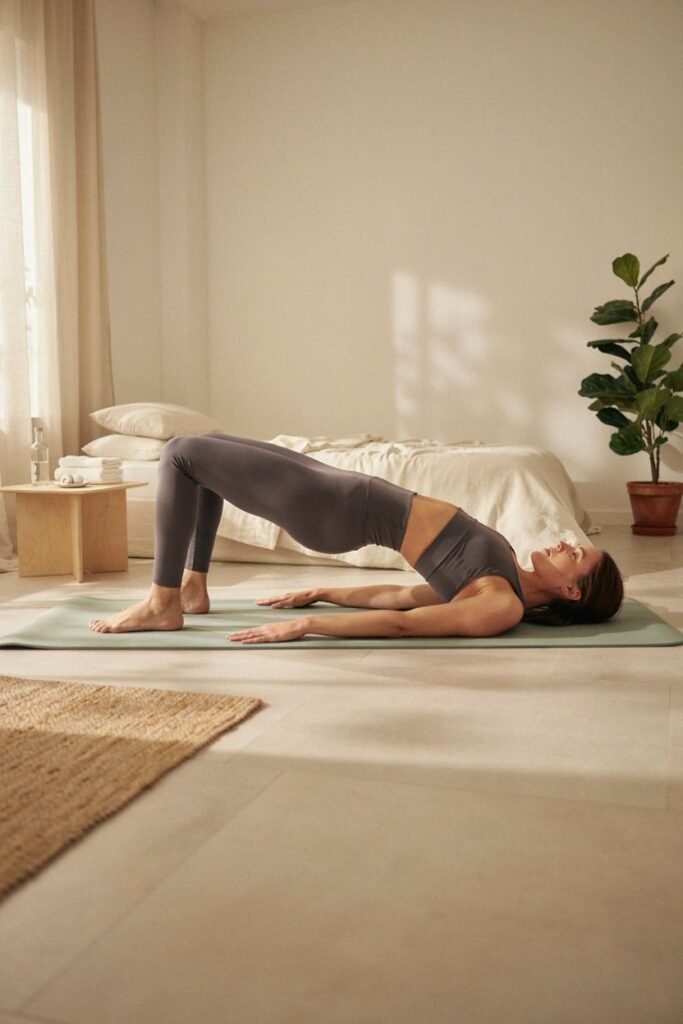
Glute bridges are one of my favorite floor exercises because they are simple, require very little space, and give me a good way to focus on my glutes and the back of my legs.
They are particularly useful when I want a break from standing exercises.
I also like using them toward the middle or end of a leg workout because they do not require much setup.
What Glute Bridges Work
• Glutes
• Hamstrings
• Core muscles
• Muscles around the hips
How to Do a Glute Bridge
- Lie on your back on a comfortable surface.
- Bend your knees and place both feet flat on the floor.
- Keep your feet approximately hip width apart.
- Place your arms beside your body with your hands resting comfortably on the floor.
- Take a breath and gently tighten your stomach.
- Press your feet into the floor.
- Slowly lift your hips toward the ceiling.
- Stop when your body forms a comfortable straight line from your shoulders toward your knees.
- Squeeze your glutes at the top.
- Hold the position briefly.
- Slowly lower your hips back toward the floor.
- Repeat without completely rushing into the next repetition.
How Many Should You Do?
A good starting point for beginners is:
• 10 to 15 repetitions
• 2 to 3 sets
• 45 seconds of rest between sets
If you find the exercise easy, try holding the top position for two or three seconds during each repetition.
My Glute Bridge Tip
The biggest difference I notice with this exercise comes from slowing it down.
Instead of lifting and immediately dropping your hips, I like to pause at the top and consciously squeeze my glutes. I also try not to use momentum.
If you feel the exercise mostly in your lower back, reduce the height of the bridge and concentrate on pressing through your feet while keeping your stomach gently engaged.
Ways to Make Glute Bridges Harder
Once regular bridges become easy, you can progress by:
• Adding a longer pause at the top
• Increasing the number of repetitions
• Performing the movement more slowly
• Trying single leg bridges once you are comfortable with the basic version
You do not need to make these changes immediately. I prefer increasing the challenge gradually rather than making the exercise unnecessarily difficult.
3. Reverse Lunges
Reverse lunges are another exercise I like including in home leg workouts because they make each leg work individually.
Unlike squats, where both legs work together, lunges require you to control your balance while one leg moves backward. This makes them useful for building lower body strength while also challenging stability.
I personally prefer reverse lunges when exercising at home because stepping backward feels easier for me to control than repeatedly stepping forward.
What Reverse Lunges Work
• Quadriceps
• Glutes
• Hamstrings
• Calves
• Core and stabilizing muscles
How to Do a Reverse Lunge
- Stand upright with your feet comfortably apart.
- Keep your chest lifted and your shoulders relaxed.
- Shift your weight onto your front foot.
- Take one leg backward.
- Place the ball of your back foot on the floor.
- Slowly bend both knees and lower your body.
- Keep your front foot firmly planted.
- Lower only as far as you can comfortably control.
- Push through the front foot.
- Bring your back leg forward and return to the starting position.
- Repeat on the other side.
How Many Should You Do?
For beginners, I suggest:
• 6 to 10 repetitions per leg
• 2 sets
• 60 seconds of rest between sets
If you are still learning the movement, even 5 controlled repetitions per side can be enough to start.
My Reverse Lunge Tip
Balance is usually the hardest part for me when I am tired, so I do not try to rush this exercise.
If you feel unsteady, perform the movement beside a wall or sturdy piece of furniture and lightly use it for support.
I also concentrate on keeping the front foot planted rather than allowing my heel to lift.
Common Reverse Lunge Mistakes
Watch out for:
• Taking an excessively large step backward
• Allowing the front knee to collapse inward
• Losing control as you lower
• Pushing off aggressively with the back foot
• Trying to go too deep before you are comfortable with the movement
A shorter range of motion is completely fine while you are learning. You can gradually increase the depth as your control improves.
4. Wall Sit
Wall sits are one of those exercises that look surprisingly easy until you actually hold the position.
I like using them toward the middle or end of a workout because they give my thighs a completely different type of challenge. Instead of repeatedly lowering and raising my body, I have to keep my muscles working while holding one position.
What Wall Sits Work
• Quadriceps
• Glutes
• Hamstrings
• Core muscles
How to Do a Wall Sit
- Stand with your back against a clear wall.
- Place your feet slightly forward and approximately hip width apart.
- Slowly slide your back down the wall.
- Bend your knees until you reach a comfortable position.
- Keep your back and shoulders against the wall.
- Keep your feet flat on the floor.
- Hold the position while breathing normally.
- Press through your feet and slowly slide back up when you are ready to finish.
You do not have to lower yourself until your thighs are perfectly parallel with the floor. If that position is too difficult, stay higher on the wall.
How Long Should You Hold It?
If you are new to wall sits, start with:
• 15 to 30 seconds
• 2 sets
• 45 to 60 seconds of rest
As you become stronger, you can gradually work toward 30 to 60 seconds.
My Wall Sit Tip
I find it much easier to focus on steady breathing instead of watching the clock.
When my thighs start burning, my natural reaction is to hold my breath or move around. Instead, I try to keep my upper body relaxed and breathe normally.
You can also use a higher position if your knees feel uncomfortable. The exercise does not have to be painful to be effective.
Common Mistakes
Try not to:
• Place your feet too close to the wall
• Let your knees move inward
• Hold your breath
• Slide lower than you can control
• Put excessive pressure through your knees
If you experience sharp or unusual pain, stop the exercise rather than trying to push through it.
5. Standing Calf Raises
Calf raises are easy to overlook when doing leg workouts at home, but I like including them because they give the lower legs some direct attention.
They are also one of the easiest exercises to perform throughout the day because they require almost no space.
What Calf Raises Work
• Calf muscles
• Muscles around the ankles
• Lower leg stabilizers
How to Do Standing Calf Raises
- Stand upright with your feet about hip width apart.
- Keep your stomach gently engaged.
- Hold onto a wall or sturdy surface if you need help with balance.
- Slowly raise your heels from the floor.
- Continue lifting until you are comfortably on the balls of your feet.
- Pause briefly at the top.
- Slowly lower your heels back toward the floor.
- Repeat the movement without bouncing.
How Many Should You Do?
A beginner can start with:
• 12 to 15 repetitions
• 2 to 3 sets
• 30 to 45 seconds of rest
Once the exercise becomes easy, increase the repetitions gradually or slow down each repetition.
My Calf Raise Tip
The lowering portion is something I try not to rush.
It is tempting to bounce up and down because the movement is so small, but slowing down makes me feel much more in control.
If balance is difficult, place one hand against a wall. There is no reason to make the exercise harder simply because you are trying to avoid using support.
How to Make Calf Raises More Challenging
Once regular calf raises become easy, you can:
• Pause longer at the top
• Lower your heels slowly
• Increase your repetitions
• Perform them one leg at a time when you have enough balance and strength
I recommend mastering the two leg version before moving to single leg calf raises.
6. Step Ups
Step ups are particularly useful if you have a stable step or low platform at home.
I like this exercise because it feels more like a natural everyday movement. Walking up stairs already requires your legs to lift your body, and step ups allow you to practice a similar pattern in a controlled way.
You do not need a high platform. In fact, I prefer starting with a lower step because it gives me better control.
What Step Ups Work
• Quadriceps
• Glutes
• Hamstrings
• Calves
• Core and stabilizing muscles
How to Do Step Ups
- Stand in front of a stable step or platform.
- Place your entire right foot firmly on the step.
- Press through the right foot and bring your body upward.
- Bring the other foot up beside it.
- Step back down carefully.
- Repeat with the opposite leg.
- Continue alternating sides.
Keep your movements controlled and make sure the surface cannot slide or tip.
How Many Should You Do?
For beginners:
• 6 to 10 repetitions per leg
• 2 sets
• 60 seconds of rest
You can increase the repetitions gradually as the movement becomes easier.
My Step Up Tip
The biggest thing I pay attention to with step ups is pushing through the foot that is already on the platform.
I try not to use the back leg to jump or push myself upward. The working leg should do most of the work.
I also prefer a low step when I am learning or when my legs are already tired.
Safety Tip
Only use a platform that is completely stable.
Avoid using a chair, loose stool, stacked books, or anything that could move underneath you. A sturdy low step is much safer.
If you do not have an appropriate surface at home, skip this exercise and use another movement instead.
7. Side Leg Raises
Side leg raises are one of the simplest exercises in this routine, but they can be surprisingly useful when you want to add some movement that targets the outer hip and side of the glutes.
I like using them between more demanding exercises because they do not require much space or equipment.
What Side Leg Raises Work
• Outer glutes
• Hip muscles
• Muscles that help stabilize the pelvis
How to Do Side Leg Raises
- Stand upright beside a wall or sturdy surface.
- Place one hand on the surface for balance.
- Keep your standing leg slightly relaxed rather than locking the knee.
- Lift the opposite leg slowly out to the side.
- Keep your toes facing mostly forward.
- Lift only as high as you can without leaning your upper body.
- Pause briefly.
- Lower the leg slowly.
- Complete your repetitions before switching sides.
How Many Should You Do?
Start with:
• 10 to 15 repetitions per side
• 2 sets
• 30 to 45 seconds of rest
You do not need to lift your leg extremely high. A smaller controlled movement is often much easier to perform correctly.
My Side Leg Raise Tip
This is an exercise where I notice the difference between controlled movement and momentum.
If I swing my leg quickly, I barely feel the muscles working. When I slow everything down and keep my body still, the exercise becomes much more noticeable.
Try to keep your hips facing forward rather than rotating your whole body toward the raised leg.
8. Glute Kickbacks
Glute kickbacks are another simple movement I like when I want to give the glutes more attention without using weights.
They require a little floor space and work particularly well when combined with glute bridges and other lower body movements.
What Glute Kickbacks Work
• Glutes
• Hamstrings
• Hip stabilizing muscles
• Core muscles
How to Do Glute Kickbacks
- Start on your hands and knees.
- Place your hands underneath your shoulders.
- Position your knees underneath your hips.
- Keep your back comfortable and neutral.
- Gently tighten your stomach.
- Keep one knee bent.
- Slowly lift that leg upward behind you.
- Stop when you feel your glute working without twisting your hips.
- Lower the leg with control.
- Complete your repetitions before switching sides.
How Many Should You Do?
Start with:
• 10 to 12 repetitions per side
• 2 sets
• 30 to 45 seconds of rest
My Glute Kickback Tip
I do not try to kick my foot as high as possible.
That usually makes it easier to arch my lower back or rotate my hips. Instead, I concentrate on moving the leg from the hip and keeping my torso as still as possible.
A smaller movement performed slowly can be much more effective than a large swinging motion.
Common Mistakes
Avoid:
• Arching your lower back
• Rotating your hips
• Swinging your leg
• Lifting the leg higher than you can control
• Letting your shoulders collapse
Keep the movement smooth and deliberate.
How I Combine These Exercises at Home
At this point, you have several options depending on how much time you have.
For a shorter workout, I might choose:
• Bodyweight squats
• Glute bridges
• Reverse lunges
• Standing calf raises
For a slightly longer session, I can add:
• Wall sits
• Side leg raises
• Glute kickbacks
The important thing is not to feel like you have to complete every exercise every time.
If I am short on time, I would rather complete four exercises properly than rush through eight exercises simply because I feel like I have to finish the entire list.
How to Make These Exercises More Challenging
Once your regular routine starts feeling easy, you can gradually increase the challenge.
Some of the easiest ways include:
• Adding a few repetitions
• Adding another set
• Slowing down the lowering portion
• Pausing at the hardest part of the movement
• Reducing your rest slightly
• Moving through a larger comfortable range of motion
• Adding light resistance when you are ready
I prefer changing only one thing at a time. For example, if 10 squats are becoming easy, I might move to 12 repetitions rather than immediately doubling the number.
That makes it easier to see how my body responds and keeps the workout manageable.
Why I Prefer Simple Exercises
There is something useful about having a workout routine that does not require much preparation.
If I need special equipment, a complicated setup, or a large amount of free time, I am much more likely to put the workout off. Simple exercises remove that barrier.
A few minutes of squats, lunges, bridges, calf raises, and other controlled movements can give you a practical lower body workout without turning your living room into a gym.
10 Easy Leg Workouts to Do at Home: Part 3
By this point, you have several exercises you can use to work your thighs, glutes, hamstrings, calves, and hips without needing a gym.
The last two exercises are movements I like because they add variety to a home leg routine while still being relatively simple to learn. I also want to show you how I would actually put all 10 exercises together instead of expecting you to perform every exercise in one workout.
For me, a good home workout is one that is challenging enough to be useful but realistic enough that I can keep doing it consistently.
9. Sumo Squats
Sumo squats are a nice variation when I want to change my regular squat stance.
The wider position changes how the movement feels, and I like using this exercise when I want to give my inner thighs and glutes more attention.
You do not need to use a very wide stance. I find that starting with a comfortable position makes it much easier to maintain good form.
What Sumo Squats Work
• Quadriceps
• Glutes
• Inner thighs
• Hamstrings
• Core muscles
How to Do a Sumo Squat
- Stand with your feet wider than shoulder width apart.
- Turn your toes slightly outward.
- Keep your chest lifted and your shoulders relaxed.
- Tighten your stomach gently before beginning the movement.
- Push your hips backward and bend your knees.
- Slowly lower your body while keeping your feet firmly planted.
- Keep your knees moving in the same general direction as your toes.
- Stop when you reach a comfortable depth.
- Press through your feet to return to standing.
- Squeeze your glutes gently at the top.
How Many Should You Do?
If you are beginning, try:
• 8 to 12 repetitions
• 2 sets
• 45 to 60 seconds of rest
Once the movement feels comfortable, you can gradually increase to 12 to 15 repetitions.
My Sumo Squat Tip
The biggest mistake I see with this variation is making the stance so wide that the movement becomes uncomfortable.
You do not need to spread your feet as far apart as possible. Start with a moderately wide stance and adjust it until you can squat comfortably while keeping your knees and toes aligned.
I also like slowing down the lowering portion. It makes the exercise feel more controlled and helps me pay closer attention to my form.
Common Sumo Squat Mistakes
Try to avoid:
• Turning your feet excessively outward
• Allowing your knees to collapse inward
• Lifting your heels
• Bending forward too much
• Using a stance that is too wide for your mobility
If the wider stance does not feel comfortable, return to regular bodyweight squats instead.
10. Single Leg Romanian Deadlift
The single leg Romanian deadlift is the most balance focused exercise in this list, so I would not recommend rushing into it if you are completely new to lower body training.
I like this movement because it works the back of the legs while also challenging balance and coordination.
You can perform it without weights first. Once you are comfortable with the movement, you can eventually hold a light dumbbell or another appropriate weight if you want additional resistance.
What the Single Leg Romanian Deadlift Works
• Hamstrings
• Glutes
• Calves
• Hip stabilizing muscles
• Core muscles
How to Do It
- Stand upright with your feet together or comfortably apart.
- Shift your weight onto one leg.
- Keep a slight bend in the standing knee.
- Slowly extend the opposite leg backward.
- At the same time, lean your upper body forward from your hips.
- Keep your back in a comfortable neutral position.
- Continue lowering your torso only as far as you can maintain control.
- Keep your hips as level as possible.
- Press through your standing foot.
- Bring your torso back upright while returning the extended leg toward the floor.
- Finish your repetitions before switching sides.
How Many Should You Do?
Because balance can make this exercise challenging, I would start with:
• 5 to 8 repetitions per leg
• 2 sets
• 60 seconds of rest
You can hold onto a wall or sturdy surface with one hand while learning the movement.
My Single Leg Deadlift Tip
I do not worry about touching the floor.
That is not the goal of the exercise.
The goal is to hinge from the hips while keeping control of your standing leg and torso. If I try to lower myself too far, I usually lose my balance and stop feeling the movement where I want it.
Think about reaching your back leg backward rather than simply bending forward.
Common Mistakes
Avoid:
• Locking your standing knee
• Rounding your back
• Rotating your hips
• Trying to touch the floor
• Moving too quickly
• Using a weight before you have mastered the bodyweight version
If balance is difficult, use a wall for support. There is nothing wrong with modifying the exercise.
All 10 Easy Leg Workouts at a Glance
You now have 10 exercises that can be mixed and matched depending on your fitness level and available time.
• Bodyweight squats
• Glute bridges
• Reverse lunges
• Wall sits
• Standing calf raises
• Step ups
• Side leg raises
• Glute kickbacks
• Sumo squats
• Single leg Romanian deadlifts
You do not need to perform all 10 every time.
In fact, I would not recommend doing that when you are just starting. Choosing four or five exercises can give you a much more manageable workout.
My Simple Beginner Leg Workout
If I were putting together a routine for someone who was just starting to exercise at home, I would keep it straightforward.
Round One
• Bodyweight squats: 10 repetitions
• Glute bridges: 12 repetitions
• Reverse lunges: 6 repetitions per leg
• Standing calf raises: 12 repetitions
Rest for 60 seconds.
Round Two
Repeat the same four exercises.
If you still feel comfortable and your form remains good, you can complete a third round.
I would not worry about how quickly you finish. Take the rest you need and concentrate on performing every repetition properly.
A More Challenging Home Leg Workout
If you already have some experience with bodyweight exercises, you can make the routine more demanding.
Try:
• Sumo squats: 12 repetitions
• Reverse lunges: 10 repetitions per leg
• Glute bridges: 15 repetitions
• Step ups: 10 repetitions per leg
• Wall sit: 30 to 45 seconds
• Calf raises: 15 to 20 repetitions
Complete two to three rounds depending on your fitness level.
If you notice your form deteriorating, that is a good reason to stop the set rather than forcing yourself to complete a specific number.
How Often Should You Do Leg Workouts at Home?
There is no single number that works perfectly for everyone.
When I am planning a lower body routine, I prefer giving my legs enough time to recover before doing another challenging leg session.
For many beginners, two leg focused workouts per week can be a reasonable starting point, with rest or lighter activity between sessions.
You can also stay active on the other days through walking, gentle mobility work, or other forms of exercise.
The important thing is to avoid thinking that you need to train your legs intensely every day to see progress.
Your body needs time to recover and adapt.
How I Progress When the Workout Gets Easier
One thing I try not to do is immediately add a huge number of repetitions whenever an exercise starts feeling easy.
Instead, I usually make small changes.
For example:
• Increase from 10 repetitions to 12
• Add one additional set
• Slow down each repetition
• Add a short pause
• Improve your range of motion
• Reduce your rest slightly
• Introduce light resistance when appropriate
Small progress is still progress.
If you can perform 10 controlled squats today and 15 controlled squats comfortably several weeks later, that is a meaningful improvement.
What If You Are Completely New to Exercise?
You do not need to complete the workout exactly as written.
If you are new to exercise, start with fewer repetitions and concentrate on learning the movements.
For example, instead of performing 10 reverse lunges per side, you might begin with five.
Instead of holding a wall sit for 30 seconds, you might hold it for 15 seconds.
Instead of performing two or three rounds, start with one.
I have found that starting slightly easier makes it much easier to build confidence. There is no benefit in making the first workout so difficult that you are afraid to repeat it.
How to Make Home Leg Workouts More Comfortable
The environment around you can make a bigger difference than people sometimes realize.
I prefer exercising on a surface where my feet feel stable. If I am doing floor exercises, I use a comfortable exercise mat rather than lying directly on a hard floor.
I also make sure there is enough space around me before starting.
Before a workout, check that:
• The floor is not slippery
• There are no objects directly around your feet
• Your shoes provide enough grip if you are wearing them
• Any step or platform you use is completely stable
• You have enough room to extend your arms and legs
These little preparations only take a minute but can make the workout feel much more comfortable.
The Biggest Mistake I Would Avoid
The biggest mistake I would avoid is trying to make every workout as difficult as possible.
There is a tendency to believe that if your legs are not completely exhausted afterward, the workout was not good enough.
I do not agree with that approach.
A workout can be effective without leaving you unable to walk comfortably afterward.
I would rather perform controlled squats, lunges, bridges, and other exercises consistently than have one extremely difficult workout followed by several days of avoiding exercise because I pushed too hard.
Pay attention to your form, breathing, balance, and how your body feels throughout the session.
When to Modify an Exercise
Not every exercise will feel right for every person.
You may find that one movement feels natural while another feels awkward. That is normal.
You can modify exercises by:
• Reducing the range of motion
• Holding onto a stable surface
• Reducing repetitions
• Taking longer rest periods
• Removing an exercise that causes discomfort
• Choosing a simpler variation
For example, if reverse lunges are difficult for your balance, practice supported reverse lunges before trying them without assistance.
If single leg Romanian deadlifts are too difficult, start with regular glute bridges or bodyweight hinges.
The goal is to build your ability gradually rather than force yourself into an advanced variation too soon.
My Final Thoughts
What I like most about these exercises is that they make lower body training feel accessible.
You do not need a large home gym or an expensive collection of equipment to start working your legs. A small amount of space and a few minutes of consistent effort can be enough to build a practical routine.
If I were starting again, I would focus on mastering the basic movements first. I would learn how to squat comfortably, control a lunge, perform a proper bridge, and keep my balance before worrying about adding resistance or making the workouts longer.
Then I would gradually increase the repetitions, add another set, slow down the movements, or introduce resistance when I felt ready.
The most useful home workout is ultimately the one you can actually stick with.
Start with a manageable number of exercises, give yourself enough recovery time, and let the routine become part of your normal week rather than treating every workout like a test.
If an exercise causes sharp pain or unusual discomfort, stop and seek appropriate professional guidance rather than trying to push through it.