Losing weight can feel confusing when every workout plan seems to promise a completely different solution. I have found that strength training is one of the easiest things to overlook when the main goal is losing weight, especially when you are focused on seeing the number on the scale move quickly.
I used to think that spending more time doing cardio was always the better option, but adding strength exercises changed the way I approached my workouts. I started paying more attention to how strong I felt, how my clothes fit, and how much easier everyday movements became.
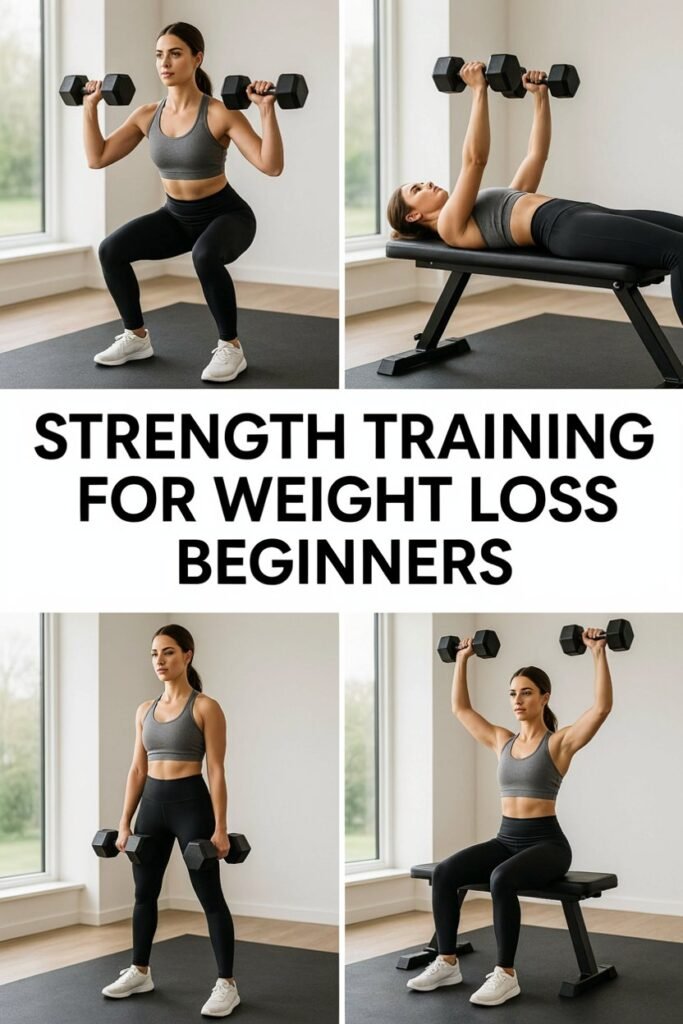
I also learned that strength training does not have to mean spending hours in a gym or lifting extremely heavy weights. You can begin with simple exercises at home and gradually make them more challenging as your body adapts.
In this guide, I want to share what has worked for me and the practical things I wish I had understood earlier, especially if you are completely new to strength training and want to use it as part of a realistic weight loss routine.
Why Strength Training Is Worth Adding to Your Weight Loss Plan
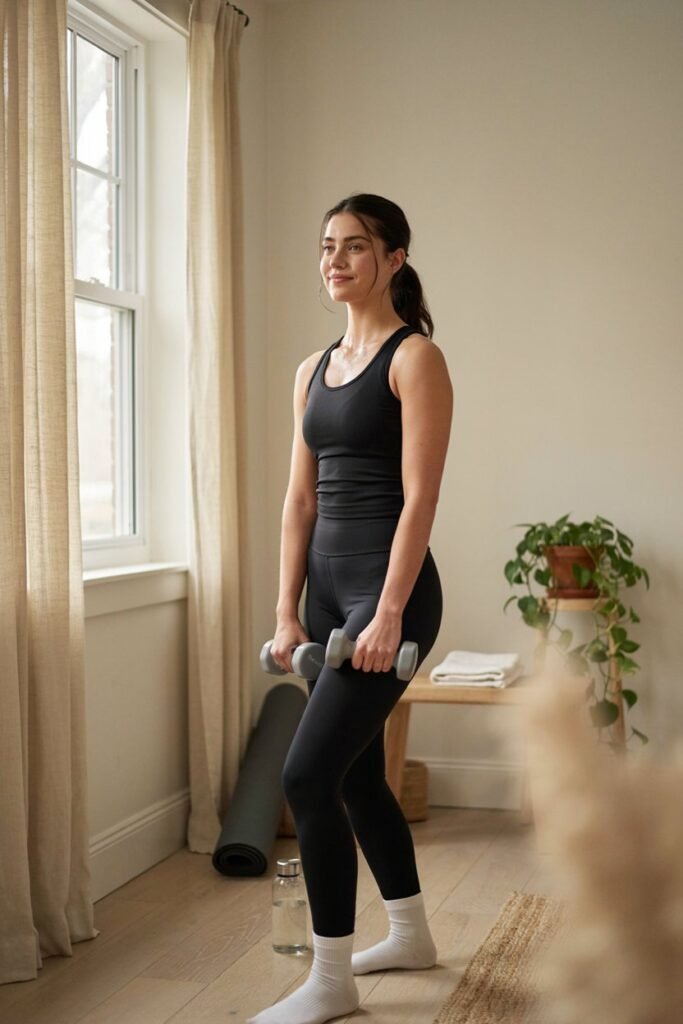
When I was focused mainly on losing weight, it was easy to judge my progress by the scale. If the number was not moving, I assumed I needed to exercise harder or spend more time doing cardio.
Strength training taught me to look at progress differently.
Weight loss still comes down largely to maintaining an appropriate calorie deficit, but the type of exercise you choose can influence how your body responds while you are losing weight.
Strength training can help you maintain muscle while you reduce body fat, improve your strength, and create a more balanced fitness routine.
That became particularly important for me because I did not want my entire fitness routine to revolve around trying to burn as many calories as possible.
I wanted to become stronger too.
Strength training also gave me something measurable to work toward. Instead of only asking whether I had lost weight, I could notice that I was using heavier dumbbells, completing more repetitions, or performing an exercise with better control.
Those small improvements made the process feel much more rewarding.
What Strength Training Actually Means for Beginners
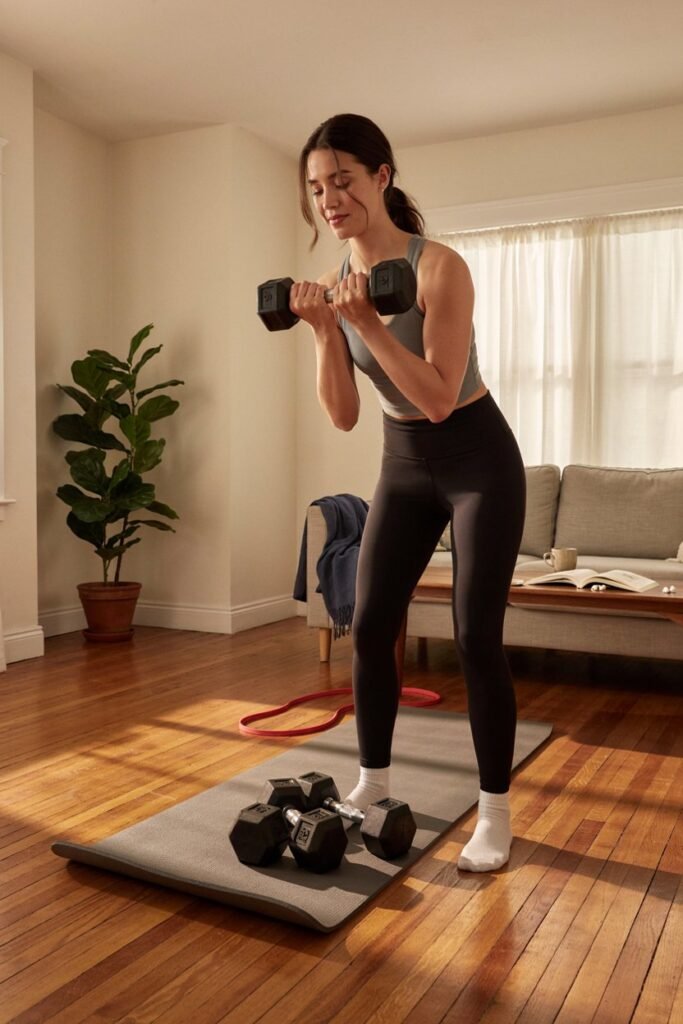
Strength training simply means using resistance to make your muscles work.
That resistance can come from dumbbells, resistance bands, machines, barbells, or even your own body weight.
You do not need a large collection of equipment to begin.
Some of the exercises I found easiest to introduce into a beginner routine were squats, glute bridges, wall push ups, dumbbell rows, lunges, shoulder presses, and core exercises.
The goal is not to make every workout exhausting.
The goal is to give your muscles a reason to adapt and become stronger.
This is something I had to remind myself of because it is easy to assume that a workout only counts if you finish it completely exhausted.
In reality, controlled movements and consistent training can be much more useful than constantly pushing yourself beyond your ability.
Can Beginners Use Strength Training to Lose Weight?
Yes, strength training can be a useful part of a weight loss plan for beginners.
However, I would not approach it as though lifting weights alone is going to make body fat disappear.
Your overall eating pattern, calorie intake, daily activity, sleep, recovery, and exercise routine all matter.
For me, strength training worked best when I stopped thinking about exercise as a way to compensate for what I had eaten.
Instead, I started looking at workouts as one part of a healthier routine.
That change in mindset made exercise feel much more sustainable.
Strength training can also help you maintain muscle as you lose weight. This matters because your goal should not simply be to become lighter. Ideally, you want to improve your body composition while becoming stronger and healthier.
Do You Need a Gym to Start Strength Training?
Absolutely not.
A gym can be useful, especially when you want access to heavier weights and different machines, but it is not a requirement for beginners.
You can start at home with bodyweight exercises or a basic pair of dumbbells.
I actually prefer keeping some simple equipment available because it removes one of the biggest excuses for skipping a workout.
If I have to drive somewhere, find parking, change clothes, and spend time getting ready before I can even start exercising, a busy day can make the workout feel much harder to fit in.
A short home workout can be much easier to complete.
You can begin with exercises such as:
- Bodyweight squats
- Glute bridges
- Wall push ups
- Reverse lunges
- Bird dogs
- Dead bugs
- Planks
As you become stronger, you can add resistance bands or dumbbells.
How Many Days a Week Should a Beginner Strength Train?
You do not need to strength train every day.
For most beginners, starting with two or three full body strength workouts per week is a much more realistic approach.
I prefer this type of schedule because it leaves room for walking, household activities, rest, and everything else that happens during a normal week.
A simple schedule could look like this:
Monday
Full body strength workout
Tuesday
Walking or normal daily activity
Wednesday
Rest or light movement
Thursday
Full body strength workout
Friday
Walking or another enjoyable activity
Saturday
Optional strength workout or light activity
Sunday
Rest
You can also start with only two workouts per week if you are completely new to exercise.
There is nothing wrong with starting smaller.
In fact, I think starting with a routine you can realistically maintain is much better than beginning with five workouts a week and giving up after two weeks.
How Long Should a Beginner Strength Workout Take?
Your workout does not need to last an hour.
A well planned beginner workout can take around 20 to 40 minutes, depending on your fitness level, the number of exercises, and how much rest you need.
When I am short on time, I would rather complete a focused 25 minute workout than spend the day telling myself that I will exercise later when I have more time.
That approach has helped me become more consistent.
You should also remember that beginners often need more rest between exercises. That is completely normal.
As your fitness improves, you will usually become more comfortable moving between exercises and controlling your breathing.
The Best Beginner Strength Training Exercises for Weight Loss
When putting together a beginner routine, I would focus on movements that train several major muscle groups rather than trying to isolate every muscle.
You also want exercises that are simple enough to learn and easy to modify.
Squats
Squats are one of the most useful lower body exercises for beginners.
They primarily work your thighs and glutes while also requiring your core to help stabilize your body.
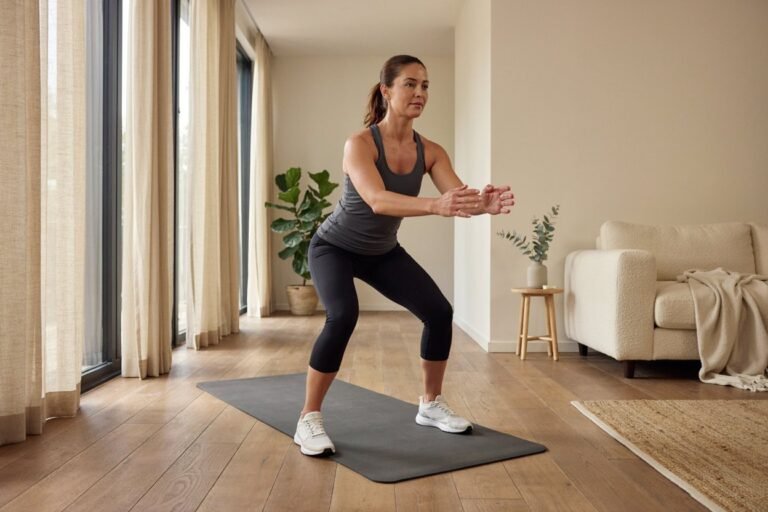
If you are new to squats, start with your body weight.
Stand with your feet around shoulder width apart. Keep your chest comfortably lifted, brace your core, and slowly lower your hips as though you are sitting toward a chair.
Then push through your feet to return to the standing position.
You do not need to squat extremely low if that makes the movement uncomfortable or causes you to lose control.
I learned that controlled repetitions are much more useful than rushing through a large number of repetitions.
Glute Bridges
Glute bridges are another beginner friendly exercise that can be performed almost anywhere.
Lie on your back with your knees bent and your feet flat on the floor.
Keep your arms relaxed beside your body. Tighten your core and squeeze your glutes as you lift your hips from the floor.
Pause briefly at the top, then lower your hips with control.
Once bodyweight bridges become easy, you can eventually add resistance.
Wall Push Ups
Traditional push ups can feel intimidating when you are starting out.
Wall push ups provide a much easier introduction.
Stand facing a wall with your hands against it. Walk your feet slightly backward, keep your body in a straight line, and bend your elbows to bring your chest toward the wall.
Push yourself back to the starting position.
As you become stronger, you can progress from wall push ups to incline push ups using a sturdy elevated surface and eventually work toward standard push ups if that is one of your goals.
Dumbbell Rows
Dumbbell rows are useful for training the muscles of your upper back and arms.
Place one hand on a sturdy bench or another stable surface if needed. Hold a dumbbell in the opposite hand and allow your arm to extend toward the floor.
Pull the dumbbell toward your torso while keeping your movement controlled.
Lower the weight slowly rather than letting it drop.
If you are completely new to resistance training, start with a light weight and spend some time learning the movement before increasing the load.
Reverse Lunges
Reverse lunges can help strengthen your legs and glutes while also challenging your balance.
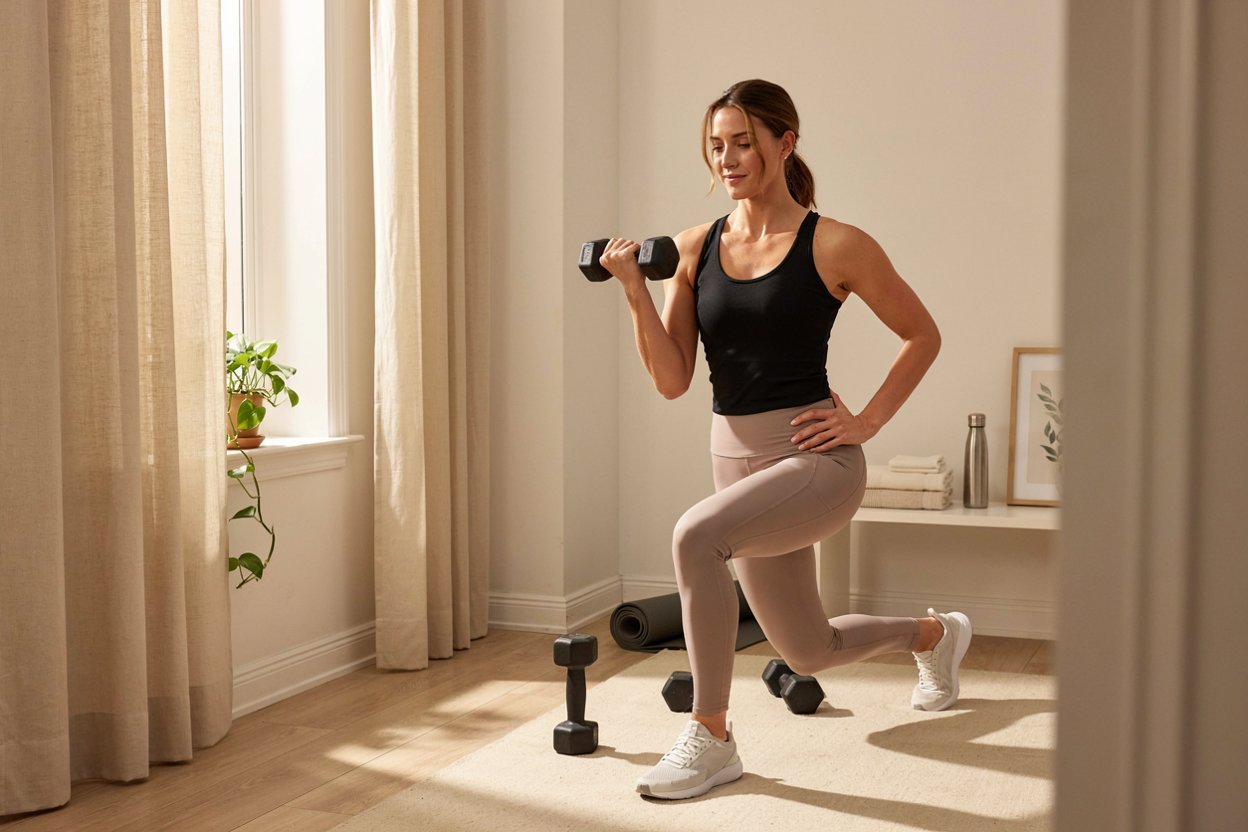
Stand upright with your feet comfortably apart.
Step one foot backward and lower your body while keeping your front foot stable. Push through the front foot to return to the starting position.
If balance is difficult, hold onto a sturdy surface.
There is no need to rush this exercise.
I would rather perform fewer controlled repetitions than turn lunges into a fast movement where I am struggling to maintain proper form.
What Should Your First Strength Workout Look Like?
If you are completely new, keep your first workout simple.
You do not need ten exercises.
A beginner full body session could include:
Bodyweight squats
2 sets of 8 to 12 repetitions
Glute bridges
2 sets of 10 to 15 repetitions
Dumbbell rows
2 sets of 8 to 12 repetitions per side
Wall push ups
2 sets of 8 to 12 repetitions
Reverse lunges
2 sets of 6 to 10 repetitions per leg
Dead bugs
2 sets of 6 to 10 repetitions per side
Rest between sets whenever you need to.
The exact number of repetitions is less important than performing the exercises with control and using a level of resistance that you can manage safely.
If this workout feels challenging at the beginning, that does not mean you are out of shape or doing something wrong.
Your body is simply learning movements it may not be accustomed to.
That is exactly why starting gradually is so important.
How Heavy Should Beginners Lift?
Choosing the right weight was something I had to learn through experience. It is tempting to pick up heavier dumbbells because you assume heavier weights will automatically produce better results. In reality, using a weight that is too heavy can make it difficult to control the movement and can cause your technique to break down.
When you are beginning, choose a weight that allows you to complete your planned repetitions with good form while making the last few repetitions feel challenging.
For example, if your workout calls for 10 repetitions, you should not feel completely exhausted by repetition three. At the same time, you should not finish all 10 repetitions feeling as though you could easily do another 30.
A useful beginner approach is to finish a set feeling like you could still perform a few additional repetitions with good technique.
Start lighter than you think you need.
You can always increase the weight later.
I found this approach much more useful than trying to prove how much I could lift. Once I became comfortable with an exercise, increasing the weight gradually felt much more natural.
How to Know When You Are Ready to Increase the Weight
You do not need to increase your dumbbell weight every workout.
Strength does not improve in a perfectly straight line, and some days will naturally feel easier than others.
Instead, pay attention to how an exercise feels.
If you can complete all of your repetitions with controlled movement and the final repetitions no longer feel particularly challenging, you may be ready to increase the resistance slightly.
You can also progress without adding weight.
For example, you might:
- Add one or two repetitions
- Perform the movement more slowly
- Improve your range of motion
- Add another set
- Move from an easier variation to a harder variation
- Increase the weight slightly
This gradual approach is known as progressive overload.
You do not need to make dramatic changes.
Small improvements repeated consistently can add up.
What Is Progressive Overload?
Progressive overload simply means gradually asking your muscles to do a little more work as they become stronger.
When I started thinking about exercise this way, I stopped feeling like every workout needed to be completely different.
You can actually repeat the same basic exercises for several weeks and make progress.
For example, imagine you begin with squats using only your body weight.
You might eventually progress from:
8 bodyweight squats
to
12 bodyweight squats
Then you could add a light dumbbell.
Later, you might increase the weight or perform another set.
That is progress.
You do not need to constantly search for a new workout.
How Many Repetitions Should Beginners Do?
There is no single repetition number that everyone has to follow.
For general beginner strength training, a range of around 8 to 12 repetitions works well for many exercises.
Some movements can comfortably use higher repetitions, particularly simpler bodyweight exercises.
For example, you might perform 10 to 15 glute bridges but use 8 to 12 repetitions for dumbbell rows.
The most important thing is that the repetitions are controlled.
Do not rush through an exercise simply because you want to reach a certain number.
If your form becomes poor halfway through the set, reduce the weight or repetitions.
How Much Rest Should You Take Between Sets?
Rest is not wasted time.
Your muscles need time to recover between challenging sets, especially when you are new to resistance training.
A beginner may need around one to two minutes of rest between many exercises, although the exact amount can vary.
If you are still breathing heavily and cannot perform the next set with reasonable control, take a little more time.
I used to feel like resting meant I was not working hard enough.
Eventually, I realized that resting allowed me to perform the next set much better.
The goal is not to turn strength training into a race.
Should You Do Cardio Before or After Strength Training?
There is no universal rule that says one approach is always best.
It depends on your goals and the type of workout you are doing.
If your main priority is getting stronger, you may prefer to perform your strength workout before longer cardio.
For example, you could lift weights and then take a walk afterward.
If you enjoy doing cardio first because it helps you warm up and feel ready to exercise, a short amount of easy movement can be perfectly reasonable.
I would avoid turning your warm up into an exhausting cardio session before lifting.
You want to have enough energy left to perform your strength exercises properly.
For weight loss, the bigger picture matters more than obsessing over whether you walked before or after your dumbbell workout.
How Walking Fits Into a Strength Training Weight Loss Plan
Walking is one of the easiest activities to combine with strength training.
You do not need to turn every day into an intense workout.
A strength training routine can be supported by regular walking and normal daily movement.
For example, you could strength train three days per week and take walks on several of the other days.
I like this approach because walking does not have to feel like another difficult workout.
You can walk while listening to music, talking with family, running errands, or simply getting outside for a change of scenery.
Those smaller amounts of movement can make your overall routine feel much more active without leaving you exhausted.
A Simple Three Day Strength Training Schedule for Beginners
Once you know the basic exercises, having a schedule makes it much easier to stay consistent.
Here is a simple structure you can adapt to your own routine.
Monday: Full Body Workout A
Bodyweight or goblet squats
Dumbbell rows
Glute bridges
Wall or incline push ups
Dead bugs
Tuesday: Walking or Light Activity
Take a comfortable walk or simply focus on getting more movement throughout the day.
Wednesday: Rest
Give your muscles time to recover.
Thursday: Full Body Workout B
Reverse lunges
Romanian deadlifts
Dumbbell shoulder presses
Incline push ups
Bird dogs
Friday: Walking
Choose an amount of walking that feels realistic for you.
Saturday: Optional Activity
You can repeat a short strength workout, take a longer walk, or do another activity you enjoy.
Sunday: Rest
Allow your body to recover before starting another week.
You can adjust this schedule around work, family commitments, travel, and your normal responsibilities.
There is no prize for following a perfect Monday through Sunday schedule.
Beginner Workout A
Here is how I would structure the first full body workout.
1. Squats
Perform 2 sets of 8 to 12 repetitions.
Use your body weight at first or hold a light dumbbell if you are already comfortable with the movement.
2. Dumbbell Rows
Perform 2 sets of 8 to 12 repetitions on each side.
Keep your back stable and avoid using momentum to move the dumbbell.
3. Glute Bridges
Perform 2 sets of 10 to 15 repetitions.
Focus on squeezing your glutes rather than simply moving your hips as quickly as possible.
4. Incline Push Ups
Perform 2 sets of 8 to 12 repetitions.
Use a stable elevated surface and adjust the height to match your current strength.
5. Dead Bugs
Perform 2 sets of 6 to 10 repetitions per side.
Move slowly and keep your core engaged.
Beginner Workout B
Your second workout can use slightly different movements while still training the entire body.
1. Reverse Lunges
Perform 2 sets of 6 to 10 repetitions per leg.
Hold onto a stable surface if you need help with balance.
2. Romanian Deadlifts
Perform 2 sets of 8 to 12 repetitions.
Start with very light dumbbells until you understand the hip hinge.
3. Dumbbell Shoulder Press
Perform 2 sets of 8 to 12 repetitions.
Keep the weights controlled throughout the movement.
4. Incline Push Ups
Perform 2 sets of 8 to 12 repetitions.
As you become stronger, gradually lower the height of the surface.
5. Bird Dogs
Perform 2 sets of 6 to 10 repetitions per side.
Focus on stability rather than speed.
What Beginners Should Know About Romanian Deadlifts
Romanian deadlifts deserve extra attention because the movement can feel unfamiliar.
The goal is not to squat down with the dumbbells.
Instead, you are practicing a hip hinge.
Hold the dumbbells in front of your thighs and keep your knees slightly bent. Push your hips backward while keeping your back in a comfortable neutral position.
Lower the dumbbells along the front of your legs until you feel a stretch through the back of your legs.
Then push your feet into the floor and bring your hips forward to return to the starting position.
You should not need to lower the dumbbells all the way to the floor.
The range of motion depends on your flexibility and ability to maintain good form.
When I was learning this movement, using lighter weights made it much easier to concentrate on what my hips were supposed to do.
That is why I would not recommend trying to lift heavy during the learning stage.
What About Belly Fat?
This is one of the biggest questions people have when they start strength training for weight loss.
Unfortunately, you cannot choose exactly where your body loses fat.
Doing hundreds of crunches will not specifically remove belly fat.
Strength exercises can strengthen the muscles underneath, but overall fat loss requires an approach that reduces body fat across the body.
This is another reason I prefer talking about strength training as part of a complete weight loss routine rather than presenting one exercise as a solution.
Your nutrition, overall calorie intake, activity level, sleep, stress, and consistency all contribute to your results.
Should You Train Your Abs Every Day?
You do not need to train your abdominal muscles every day.
Your core is involved in many strength exercises already, including squats, lunges, rows, deadlifts, and carries.
A few focused core exercises during your weekly workouts can be enough for many beginners.
When I was building my own routine, I found it much more useful to train my entire body instead of spending most of my workout doing abdominal exercises.
A stronger core is helpful, but it should be part of a balanced routine.
What Should You Eat When Strength Training for Weight Loss?
Exercise is only one part of the process.
If your goal is weight loss, your overall food intake matters.
I try to keep meals simple rather than following complicated rules that are difficult to maintain.
A balanced meal can include a source of protein, vegetables or fruit, a satisfying carbohydrate source, and some healthy fat depending on the meal.
Protein is particularly useful because it helps support muscle while you are working on your strength and losing weight.
Good food choices can include eggs, chicken, fish, Greek yogurt, beans, lentils, lean meat, cottage cheese, tofu, vegetables, fruits, potatoes, rice, oats, and whole grains.
You do not have to completely eliminate carbohydrates to lose weight.
You also do not need to eat perfectly.
What matters most is the overall pattern of your diet and whether it supports your goals.
Do You Need Protein Powder?
No.
Protein powder can be convenient, but it is not essential for strength training or weight loss.
If you can get enough protein from regular foods, there is nothing wrong with doing that.
I prefer thinking of supplements as convenient additions rather than something that should replace a balanced diet.
If you struggle to get enough protein from meals, a protein shake can be a practical option, but it should not be treated as a shortcut to results.
Why You Should Not Expect the Scale to Change Immediately
One of the hardest parts of starting strength training can be becoming comfortable with normal fluctuations in body weight.
Your weight can change because of water, food intake, sodium, digestion, hormones, and other factors.
That means a few days of training does not necessarily produce an obvious change on the scale.
This is why I like tracking other signs of progress too.
You might notice that:
Your clothes fit differently.
You can carry groceries more easily.
Your squats feel more controlled.
You can use a heavier dumbbell.
You can walk for longer without feeling as tired.
You recover more quickly after workouts.
Those changes matter.
The scale is useful, but it is not the only way to measure progress.
Common Strength Training Mistakes Beginners Should Avoid
Strength training became much easier for me once I stopped trying to do everything at once. When you are motivated to lose weight, it is easy to believe that more workouts, heavier weights, and longer sessions will automatically produce faster results.
That mindset can quickly leave you tired and frustrated.
Beginners usually do better when they focus on learning the movements, creating a manageable schedule, and gradually increasing the challenge.
Here are some of the mistakes I think are worth avoiding.
Starting With Too Much Weight
Using heavier weights does not automatically mean a better workout.
If you have to swing the dumbbell, rush the movement, or change your posture just to finish a repetition, the weight is probably too heavy for your current ability.
Start lighter and build from there.
Training Every Day
Your muscles need time to recover.
Strength training every day is not necessary for most beginners, especially if you are training your entire body.
Two or three well planned sessions can be much more useful than exercising intensely every day and eventually becoming too tired to continue.
Changing Your Workout Every Week
It can be tempting to constantly search for new workouts online.
I understand the temptation because there are always new routines to try.
But changing your exercises constantly can make it difficult to know whether you are actually getting stronger.
Repeating the same basic movements for several weeks gives you an opportunity to improve your technique and gradually increase the challenge.
Ignoring Your Form
Good form should come before adding more weight.
If you are unsure how to perform an exercise, spend some time learning the movement with little or no resistance.
This is especially important with exercises such as squats, lunges, Romanian deadlifts, and shoulder presses.
Believing Soreness Means You Had a Better Workout
Being extremely sore does not automatically mean your workout was more effective.
Some soreness can happen when you introduce your muscles to something new, but you should not use soreness as your main measurement of progress.
A good workout can leave you feeling challenged without making it difficult to move the next day.
How to Make Strength Training Fit Into a Busy Life
One of the biggest lessons I learned was that the perfect workout schedule does not exist.
Some weeks are easy to organize.
Other weeks are filled with work, family responsibilities, errands, appointments, cooking, and everything else that needs attention.
That is why I stopped thinking that every workout had to be long.
If I have limited time, I can shorten the session and still get something useful done.
A 20 minute workout is better than skipping exercise because I could not find an hour.
I also found it helpful to keep my equipment somewhere accessible.
When dumbbells or resistance bands are easy to reach, there is less preparation involved.
Sometimes the hardest part is simply getting started.
What If You Miss a Workout?
Missing one workout does not ruin your progress.
This is something worth remembering because weight loss can become mentally exhausting when you feel like every decision has to be perfect.
If you miss Monday, you do not need to punish yourself with an extra long workout on Tuesday.
Simply continue with your next planned session.
Consistency is not about completing every workout without exception.
It is about continuing to return to your routine.
There will be busy days.
There will be weeks when your schedule changes.
What matters is what you do most of the time.
How to Make Your Strength Workouts More Challenging
Once your workouts begin to feel easier, you can gradually increase the challenge.
You might start by adding a few repetitions.
If you were previously doing 8 repetitions, you could work toward 10 or 12.
Once that becomes comfortable, you could increase the weight slightly.
Another option is to add a third set to one or two exercises.
You can also make an exercise more difficult by progressing to a harder variation.
For example, you might move from:
Wall push ups
to
Incline push ups
to
Lower incline push ups
to
Standard push ups
You do not have to make every change at once.
Choose one form of progression and give your body time to adapt.
How Long Does It Take to See Results From Strength Training?
There is no exact timeline that applies to everyone.
Your results can depend on your starting point, nutrition, training consistency, sleep, activity level, genetics, and many other factors.
You may notice improvements in strength before you see significant changes in your body weight.
That is completely normal.
For me, some of the most encouraging changes were not immediately visible.
An exercise that once felt difficult could become easier.
I could complete more repetitions without stopping.
I could use a heavier weight while maintaining control.
Those improvements gave me motivation to keep going even when the scale was not changing as quickly as I wanted.
What Progress Should You Track?
Tracking your progress can help you see changes that you might otherwise overlook.
You do not need to record everything.
A few simple measurements can be enough.
Your Strength
Write down the exercises, weights, sets, and repetitions you complete.
This allows you to see whether you are gradually getting stronger.
Your Measurements
You can measure areas such as your waist, hips, thighs, and arms if you are comfortable doing so.
Measurements can sometimes show changes that the scale does not immediately reveal.
Your Clothing
Pay attention to how your clothes fit.
A pair of jeans becoming more comfortable can be a useful sign of progress.
Your Energy
Notice how you feel during normal daily activities.
Walking, climbing stairs, carrying groceries, and doing household tasks may gradually become easier.
Progress Photos
If you are comfortable taking them, occasional progress photos can provide another way to compare changes.
You do not need to take photos every day.
Taking them under similar conditions every few weeks can give you a more useful comparison.
Should Beginners Lift Weights Before or After Losing Weight?
You do not have to wait until you lose weight before beginning strength training.
You can start while you are working toward your weight loss goal.
In fact, starting strength training early can help you develop the habits and strength you want to maintain later.
I would not recommend thinking of strength training as something you only do after reaching a certain number on the scale.
It can be part of the process from the beginning.
Can You Strength Train at Home for Weight Loss?
Yes.
Home workouts can be very effective for beginners.
You can start with bodyweight exercises and gradually add equipment as you become more comfortable.
A simple home setup might include:
A pair of dumbbells
A resistance band
An exercise mat
A sturdy chair or bench
You do not need a room full of equipment.
In fact, having too much equipment can sometimes make the process more complicated than it needs to be.
A few versatile pieces are enough to create a variety of workouts.
How to Combine Strength Training With Cardio
You do not have to choose between strength training and cardio.
They can serve different purposes and work well together.
Strength training gives you resistance based exercise that challenges your muscles.
Walking, cycling, swimming, jogging, or other forms of cardio can add more movement and cardiovascular activity.
For beginners, I would focus on activities you actually enjoy.
If you hate running, you do not need to force yourself to run every morning.
Walking can be an excellent starting point.
If you enjoy cycling, use a bike.
If you enjoy dancing, dance.
The best activity is often the one you are willing to keep doing.
A Simple Weekly Weight Loss Routine for Beginners
If you want a practical example, you could structure your week like this.
Monday
Full body strength workout
20 to 40 minutes
Tuesday
Walking or normal daily activity
Wednesday
Full body strength workout
20 to 40 minutes
Thursday
Rest or easy walking
Friday
Full body strength workout
20 to 40 minutes
Saturday
Optional longer walk or enjoyable activity
Sunday
Rest
If three strength workouts feel like too much, start with two.
You can always add another session later.
The goal is to create a routine that fits your life rather than forcing your life around a workout schedule.
Beginner Strength Training FAQ
Can strength training help beginners lose weight?
Yes. Strength training can be an effective part of a weight loss plan, especially when combined with an appropriate diet and regular physical activity. It can also help you maintain muscle while losing weight.
How many days a week should a beginner lift weights?
Two or three full body strength workouts per week can be a practical starting point for many beginners.
Is 20 minutes of strength training enough?
Yes. A short, focused workout can still be useful. Consistency matters more than making every workout extremely long.
Can I strength train at home?
Yes. Beginners can start with bodyweight exercises and gradually add dumbbells or resistance bands.
Do I need heavy weights to lose weight?
No. You do not need extremely heavy weights. Choose resistance that challenges you while still allowing you to maintain good technique.
Can strength training reduce belly fat?
Strength training can help support overall fat loss and improve muscle strength, but you cannot specifically choose where your body loses fat. Overall body fat reduction comes from your broader nutrition and activity habits.
Should I do cardio every day if I am trying to lose weight?
You do not have to do cardio every day. Walking and other forms of movement can be included according to your fitness level, schedule, and preferences.
What should I do if I am sore after a workout?
Give your body time to recover and avoid training intensely through significant pain. Gentle movement can be comfortable for some people, but unusual or severe pain should not be ignored.
Should I work out if I am completely exhausted?
Not necessarily. Recovery is part of training. If you are unusually fatigued, taking a rest day may be more helpful than forcing yourself through another demanding workout.
Final Thoughts
Strength training does not have to become another complicated part of your life.
You do not need a perfect gym routine, expensive equipment, or hours of free time.
Start with a few basic movements, train consistently, and give yourself time to improve.
What helped me most was shifting my focus away from trying to make every workout as difficult as possible. I started paying more attention to whether I could keep showing up, whether my technique was improving, and whether I was becoming stronger.
That made the process much easier to maintain.
If you are beginning your weight loss journey, start with two or three strength sessions each week, keep your workouts simple, stay active outside your workouts, and build your nutrition around foods that keep you satisfied.
Do not worry about being perfect.
Your first goal is simply to build a routine that you can see yourself continuing.
As that routine becomes familiar, you can gradually increase the weights, repetitions, or difficulty of your exercises.
The small improvements may not seem important when you look at them individually, but they can make a meaningful difference when you continue working toward them week after week.