
Losing 25 pounds sounds like a big goal, especially when you are trying to fit healthy eating and exercise into a normal, busy life. I have found that the hardest part is usually not knowing what foods are healthy or which exercises burn calories.
The real challenge is creating a routine that still works when life gets busy, you have family meals, cravings, weekends, and days when you simply do not feel motivated.
I have learned that trying to change everything at once usually makes weight loss feel harder than it needs to be. What worked better for me was focusing on a few habits that I could repeat consistently and then building from there.
Instead of looking at 25 pounds as one enormous goal, I prefer breaking it into smaller milestones and paying attention to how I eat, move, sleep, and handle setbacks along the way. In this guide, I will share the practical approach I use to work toward losing 25 pounds while building habits that can make maintaining the weight much easier afterward.
Start by Looking at Your Current Routine

Before changing your diet or creating a new workout schedule, take a realistic look at what you are already doing.
I think this is one of the most overlooked parts of losing weight.
It is tempting to immediately search for the perfect meal plan or the hardest workout routine.
I have found it much more useful to first notice the small habits that are adding extra calories to my day without me really thinking about them.
For example, I might have a balanced breakfast and lunch and still find that my overall eating is not where I want it to be because I am constantly picking at food in the afternoon or eating larger portions at dinner.
Sometimes it is not one particular food causing the problem. It is the combination of several small habits.
Take a normal day and ask yourself a few honest questions.
What do I usually eat for breakfast?
How large are my portions?
Do I snack when I am actually hungry or simply bored?
How often do I drink calories?
Do I eat more on weekends?
How often do I order takeout?
Am I getting enough protein?
How much do I actually move during the day?
These questions can tell you much more than simply deciding that you need to eat less.
Break the 25 Pound Goal Into Smaller Goals

Twenty five pounds can feel overwhelming when you look at the entire number at once.
Instead of thinking about losing all 25 pounds immediately, I prefer to focus on smaller milestones.
You could begin by focusing on the first five pounds. Once that feels manageable, work toward the next five.
This changes the way you look at the process.
You are no longer waking up every morning thinking about how far away you are from losing 25 pounds. You are concentrating on what you can do today.
For me, that means paying more attention to the habits I can control rather than constantly checking whether the scale has moved.
Weight does not always decrease in a perfectly straight line. Your weight can change because of water retention, food volume, sodium, hormones, digestion, and other normal factors.
A higher number one morning does not automatically mean that your plan has stopped working.
Look at the overall trend instead of allowing one weigh in to determine how you feel about your progress.
Create a Manageable Calorie Deficit
To lose body weight, you generally need to consume fewer calories than your body uses over time.
That does not mean you need to starve yourself.
This is where I think many weight loss attempts become unnecessarily difficult. People often assume that losing weight requires eating tiny meals, skipping breakfast, eliminating carbohydrates, or surviving on salads.
You do not have to make your diet miserable.
A more practical approach is to make small changes that reduce your overall calorie intake while keeping your meals satisfying.
For example, you could reduce the amount of calorie dense sauces you use, choose water instead of a sugary drink, slightly reduce your dinner portion, add more vegetables to your plate, or replace a high calorie snack with something more filling.
Small changes can become meaningful when you repeat them consistently.
I also prefer making one or two changes at a time instead of completely rebuilding my diet overnight.
When you change everything at once, it becomes difficult to know which habits you can actually maintain.
Build Meals Around Protein
Protein has become one of the most useful parts of my approach to eating for weight loss.
When I build a meal around a good source of protein, I usually find it much easier to stay satisfied afterward.
Simple options include eggs, Greek yogurt, chicken, turkey, fish, tuna, lean beef, cottage cheese, beans, and other protein rich foods.
A breakfast might be eggs with whole grain toast and fruit.
Lunch could be grilled chicken with rice and vegetables.
Dinner could be salmon with potatoes and a large serving of vegetables.
The point is not to make every meal complicated.
I have found that simple meals are often much easier to repeat during a busy week.
Protein also works well when combined with foods that provide fiber, such as vegetables, fruits, beans, oats, potatoes, and whole grains.
Instead of constantly searching for foods with the fewest calories, think about whether your meal is actually going to keep you satisfied.
That small change in thinking can make weight loss much easier to manage.
Make Your Portions Work for You
You do not necessarily need to weigh every ingredient or track every bite to start making progress.
Portion awareness can make a noticeable difference.
One habit I like is putting my meal on a plate rather than eating directly from a package or large serving dish.
It gives me a much better idea of how much I am actually eating.
I also try to make protein and vegetables a major part of my main meals before adding the foods that are more calorie dense.
This does not mean avoiding rice, pasta, bread, potatoes, or other carbohydrates.
It simply means being aware of how much I am eating.
There is a big difference between enjoying a reasonable serving of a favorite food and continuing to eat simply because there is still food sitting in front of you.
Eating more slowly can also help.
When I eat too quickly, I can finish a meal before I have really noticed how satisfied I am.
Taking a little more time gives me the opportunity to recognize when I have had enough.
Do Not Remove Every Food You Enjoy
One of the biggest lessons I have learned about sustainable weight loss is that I do not want a diet that makes normal life impossible.
If I tell myself that I can never eat pizza, dessert, pasta, burgers, or another favorite food again, I am making the process much harder than it needs to be.
Instead, I focus on how those foods fit into my overall routine.
A favorite meal can still be part of a healthy eating pattern.
The difference is usually the frequency, portion size, and what the rest of the day looks like.
If I want something more indulgent, I would rather enjoy a reasonable portion and move on than spend the entire day trying to resist it and eventually overeat.
That mindset has helped me avoid the feeling that one less healthy meal has ruined everything.
One meal is just one meal.
The next meal is another opportunity to get back to your normal routine.
Start Moving More Before Making Exercise Complicated
Exercise is important, but you do not need to create an extreme workout schedule to begin losing weight.
I have found that regular movement is much easier to maintain when it becomes part of normal life.
Walking is a great example.
You can walk after meals, take a longer evening walk, move around more during the day, take the stairs when practical, or simply spend less time sitting.
These activities may seem small individually, but they can help you become more active without making exercise feel like another major responsibility.
If you enjoy structured workouts, strength training is also worth including.
A simple routine can include exercises such as squats, lunges, rows, presses, hip hinges, and core exercises.
You do not need to spend hours in the gym.
The goal at this stage is to create a routine that you can realistically repeat.
That is more valuable than completing an intense workout for one week and then abandoning it because it is too difficult to maintain.
Focus on Consistency Instead of Perfection
This is probably the most important part of the entire process.
There will be days when you eat more than planned.
There will be weekends when your routine changes.
There will be days when you do not have time to exercise.
There may even be weeks when the scale barely changes.
None of those things mean you have failed.
I have found that the biggest difference comes from what happens afterward.
If one large meal turns into an entire weekend of overeating because you believe you have already ruined your progress, it becomes much harder to get back on track.
Instead, treat the next meal as a normal meal.
You do not need to punish yourself with excessive exercise or by skipping food the next day.
Simply return to the routine that was working.
That is the mindset that makes losing 25 pounds much more realistic and, eventually, makes keeping those pounds off much easier.
Plan Your Meals Before You Get Too Hungry
One thing that has made a noticeable difference for me is having some idea of what I am going to eat before the day gets too busy.
I do not mean preparing a perfect meal plan every Sunday or cooking every meal in advance. Sometimes I simply decide what I will have for breakfast, lunch, and dinner so I am not making every food decision when I am already hungry.
That small amount of planning can prevent a lot of unnecessary snacking.
When I am extremely hungry, it is much easier to grab whatever is convenient. A planned meal gives me something to work toward instead.
I like keeping a few simple foods available that can be turned into a meal quickly. Eggs, Greek yogurt, chicken, tuna, fruit, vegetables, potatoes, rice, oats, and other basic ingredients are useful because they do not require complicated recipes.
The goal is not to make eating perfectly organized.
The goal is to make the healthier choice easier when the day does not go according to plan.
Be Careful With Liquid Calories
Drinks are easy to overlook when you are trying to lose weight.
A drink may not make you feel as full as a meal, but it can still contribute a significant amount of calories to your day.
This is one reason I pay attention to what I drink when I am trying to lose weight.
Water is my main choice, but that does not mean every other drink has to disappear forever. I simply try to be more aware of how often I am drinking sugary beverages, sweetened coffee, large specialty drinks, or other calorie containing drinks.
If you currently drink several high calorie beverages every day, replacing some of them with lower calorie options can be a relatively simple way to reduce your overall calorie intake without making your meals smaller.
I would rather make an easy change that I can maintain than make ten difficult changes that last for a few days.
Do Not Let Weekends Undo Your Progress
Weekends can be surprisingly important when you are trying to lose 25 pounds.
It is easy to follow your plan during the week and then completely change your eating habits on Saturday and Sunday.
Maybe breakfast becomes larger, lunch turns into takeout, dinner becomes a restaurant meal, and snacks continue throughout the evening.
There is nothing wrong with enjoying your weekend.
The problem is when the weekend becomes a complete break from the habits that helped you lose weight.
I try to keep some structure even when I am eating out or attending family meals.
I can still enjoy the foods I like while being mindful of portions and how often I am reaching for something simply because it is available.
This approach feels much more realistic than trying to eat perfectly during the week and then treating the weekend like a reward.
Learn How to Handle Cravings
Cravings are normal, and I do not think the best strategy is to pretend they do not exist.
When I completely forbid a food I enjoy, I can end up thinking about it even more.
Instead, I try to understand what is actually causing the craving.
Sometimes I am genuinely hungry because I did not eat enough earlier.
Sometimes I am tired.
Sometimes I simply want something sweet after dinner.
Recognizing the difference helps me respond instead of automatically eating.
If I am hungry, I will have something that actually fills me up.
If I want a treat, I can have a reasonable portion and enjoy it.
I also find it helpful not to keep large quantities of highly tempting foods within easy reach when I am trying to be more consistent. Having a single serving available is very different from having an entire package sitting beside me while I am watching television.
You do not need perfect willpower.
Your environment matters too.
Keep Walking Even When You Are Not Working Out
I have learned that structured workouts are only one part of being active.
There are plenty of days when I may not have the time or energy for a full workout. That does not mean the entire day has to become inactive.
A walk can still count.
I might walk after eating, spend more time moving around the house, take a short walk outside, or simply make an effort to spend less time sitting.
These small decisions are especially useful because they do not require much preparation.
If you are currently doing very little activity, do not feel like you need to suddenly start exercising for an hour every day.
Start with something you can actually repeat.
You can always increase your activity later.
Add Strength Training to Your Routine
If your goal is to lose weight while improving the way your body looks and feels, strength training can be a valuable part of the process.
I prefer keeping strength workouts straightforward.
You can train your entire body with movements such as squats, lunges, rows, presses, glute bridges, hip hinges, and core exercises.
The exact exercises are less important than learning proper technique and gradually making the workouts more challenging as your fitness improves.
You can use bodyweight exercises, dumbbells, resistance bands, or gym equipment depending on what you have available.
I also think strength training is easier to stick with when you stop treating every workout as a test.
You do not need to finish completely exhausted.
A good workout is one that you can recover from and eventually repeat.
Give Your Sleep More Attention
Sleep is easy to ignore when you are focused on food and exercise, but it is part of the bigger picture.
When I am tired, making good food decisions becomes much harder.
I am more likely to reach for convenient foods, snack late at night, skip exercise, or simply lose motivation.
That does not mean one bad night of sleep will stop weight loss.
It means that your overall routine matters.
Try to create a regular bedtime when possible. Give yourself enough time to sleep, reduce unnecessary distractions before bed, and make your bedroom comfortable.
You do not need to create a perfect nighttime routine.
Even improving your sleep schedule gradually can make the rest of your weight loss habits easier to manage.
Find a Way to Track Your Progress
Tracking can be useful, but it does not have to become an obsession.
When I want to understand whether what I am doing is actually working, I look at the bigger picture rather than focusing on one number.
You can track your weight, waist measurement, clothing fit, workouts, steps, meals, or simply how consistently you are following your habits.
If you weigh yourself, remember that your weight can fluctuate from one day to another.
A temporary increase does not necessarily mean you gained body fat.
Looking at your average weight and the trend over several weeks gives you a much better idea of what is happening.
I also like paying attention to non scale changes.
Maybe your clothes fit better.
Maybe walking feels easier.
Maybe you can lift heavier weights.
Maybe you are no longer reaching for snacks every night.
Those changes matter too.
What to Do When Your Weight Loss Slows Down
At some point, you may notice that your weight is no longer dropping as quickly as it did in the beginning.
This can be frustrating.
It is also normal for weight loss to become slower as your body weight decreases.
Before drastically reducing your food intake, take another look at your routine.
Have your portions gradually become larger?
Are you snacking more frequently?
Have weekends become less structured?
Are you drinking more calories?
Has your activity decreased?
Are you still following the habits that helped you lose the first several pounds?
These questions can reveal what is happening.
Sometimes the problem is not that your diet stopped working.
Sometimes your routine simply became more relaxed without you noticing.
If you genuinely need to make a change, make a small adjustment rather than completely starting over.
That is much easier mentally and physically.
Do Not Use Exercise to Punish Yourself for Eating
I strongly believe that exercise should not become a punishment.
If you eat a large meal and immediately feel that you need to exercise for hours to compensate, you can quickly develop an unhealthy relationship with both food and movement.
Exercise should help you become stronger, fitter, more active, and healthier.
Food is not something you need to earn.
If you have an unusually high calorie day, simply return to your normal routine afterward.
You do not need to starve yourself the next day.
You do not need to skip every carbohydrate.
You do not need to spend hours doing cardio.
One day does not determine your entire weight loss journey.
Your repeated habits do.
Make Your Home Support Your Goal
Your surroundings can make healthy habits easier or harder.
I have found that having convenient foods available makes a difference on busy days.
Keep foods that you actually want to eat regularly within easy reach.
Wash fruit when you bring it home.
Keep simple protein sources available.
Prepare vegetables when you have time.
Make healthy meals convenient rather than treating them like a special project.
At the same time, you do not have to remove every treat from your kitchen.
I prefer having reasonable portions available instead of creating an environment where one food becomes completely forbidden.
The more normal your eating environment feels, the easier it is to maintain your habits long term.
Give Yourself Room for Real Life
Your weight loss plan has to fit your actual life.
There will be birthdays, holidays, restaurant meals, family gatherings, vacations, busy workdays, and evenings when you simply do not feel like cooking.
I do not want a plan that only works when everything goes perfectly.
I want something that still works when life gets messy.
That means learning how to make reasonable choices in different situations.
At a restaurant, I might choose a meal with a good protein source and vegetables while still enjoying something I like.
At a family gathering, I can eat with everyone rather than bringing a completely separate meal.
During a busy day, I can choose a simple meal instead of deciding that because I could not follow my ideal routine, I might as well abandon the day.
That flexibility is what makes the process sustainable.
Remember That You Do Not Have to Be Perfect
There will be weeks when you do everything right and the scale barely changes.
There will also be days when you eat more than you intended.
Do not turn those moments into a reason to quit.
I have found that progress becomes much easier when I stop expecting myself to be perfect.
The goal is not to have every meal be perfect.
The goal is to make the better choice more often.
If you have one high calorie meal, your next meal can still be balanced.
If you miss one workout, you can exercise the next time you have the opportunity.
If you have a difficult week, you can start rebuilding your routine the following week.
That ability to recover from setbacks is much more important than having an uninterrupted streak.
Start Thinking About Maintenance Before You Reach 25 Pounds
One mistake I see often is waiting until the goal weight is reached before thinking about maintenance.
I prefer thinking about it during the weight loss process.
Ask yourself what habits you could realistically continue after losing the weight.
If your diet requires foods you hate, workouts you cannot stand, and rules that make normal life difficult, maintaining the results will be much harder.
But if you lose weight by eating balanced meals, controlling portions, walking regularly, strength training, sleeping better, and allowing yourself some flexibility, those same habits can become part of your normal lifestyle.
That is where the real long term progress comes from.
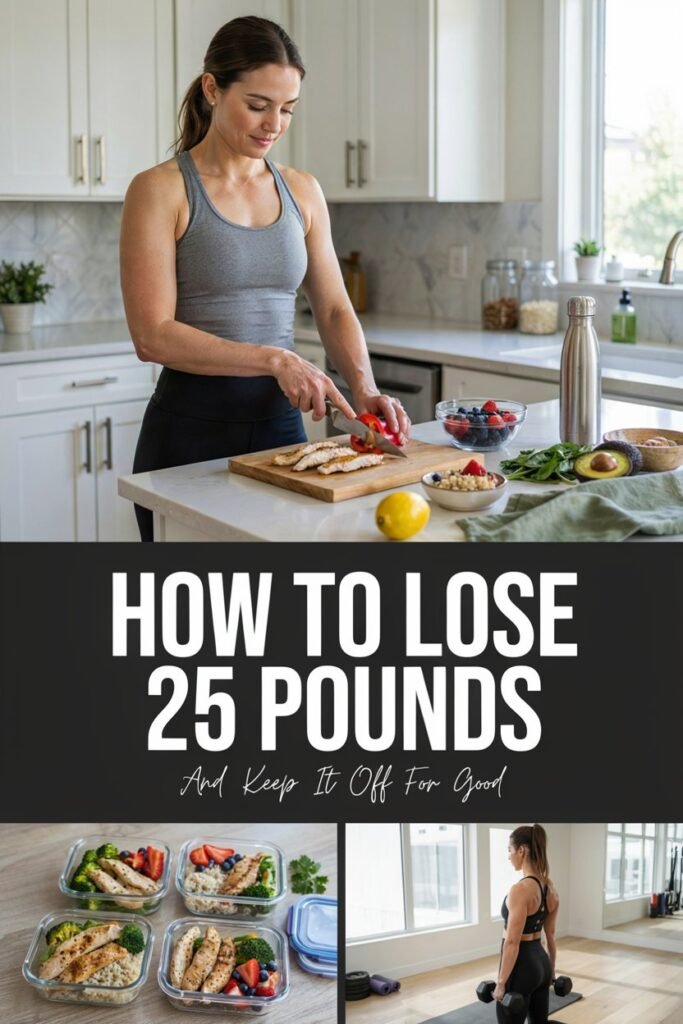
How to Lose 25 Pounds and Keep It Off
What to Do After You Lose the 25 Pounds
Reaching the 25 pound mark can feel like the finish line, but I think it is better to look at it as the beginning of the maintenance phase.
This is where many people struggle.
They spend months carefully watching their food, exercising regularly, and paying attention to their portions. Then they reach their goal and slowly return to the habits they had before losing the weight.
Eventually, the weight starts coming back.
I do not want to approach weight loss that way.
The habits that helped me lose weight need to become part of my normal lifestyle. That does not mean I need to stay on a strict diet forever. It means keeping the habits that made the biggest difference while allowing more flexibility.
I can still enjoy restaurant meals, desserts, holidays, and favorite foods.
The difference is that those foods are part of my overall lifestyle rather than the foundation of it.
Keep Eating the Way That Helped You Lose Weight
Once you reach your goal, you may notice that your hunger changes and your body requires a different amount of food than it did before.
That is normal.
You may need to eat somewhat more to maintain your weight than you did while actively losing weight, but that does not mean returning to your previous eating habits.
I would keep the basics that worked.
Protein would still be a regular part of my meals.
Vegetables and fruit would still be common.
Portions would still matter.
Water would still be my main drink.
Favorite foods would still have a place, but they would not become everyday habits simply because I reached my goal.
This is why I prefer thinking about sustainable habits rather than thinking about a temporary diet.
A temporary diet ends.
Healthy habits can continue.
Do Not Stop Exercising Once You Reach Your Goal
Exercise should not disappear just because the scale reaches your target.
You do not have to exercise more and more to maintain your weight, but keeping regular movement in your routine can help you stay active and support your overall health.
I would continue strength training several times a week if possible.
I would also continue walking and finding simple ways to stay active throughout the day.
The biggest change is that exercise no longer needs to feel like something I am doing only to lose weight.
It becomes part of my lifestyle.
That shift makes it much easier to continue.
Keep an Eye on Your Weight Without Obsessing Over It
After losing 25 pounds, I think it is useful to occasionally check where things are going.
This does not mean stepping on the scale multiple times every day and worrying about every small fluctuation.
It simply means paying attention.
If your weight increases slightly, there is no reason to panic.
Your weight naturally moves up and down.
But if you notice a steady upward trend over several weeks, that is useful information.
You can respond early by looking at your portions, activity, snacks, drinks, and weekend habits.
It is much easier to make a few small adjustments than to ignore gradual weight regain until it becomes a much larger problem.
Learn Your Personal Warning Signs
Everyone has different habits that can signal that they are moving away from their routine.
For me, it might be eating more snacks in the evening, ordering takeout more often, becoming less active, or stopping my normal workouts.
Those little changes matter because they can happen gradually.
You may not notice anything at first.
Then one day you realize that your normal routine has completely changed.
Learning your own warning signs allows you to make adjustments before you feel like you need to start another major diet.
That is one of the biggest advantages of building awareness during the weight loss process.
Do Not Panic After a Higher Number on the Scale
One of the easiest mistakes to make after losing weight is reacting emotionally to a temporary increase.
You may eat a salty restaurant meal and weigh more the next morning.
You may eat more carbohydrates than usual.
You may have eaten later than normal.
You may simply be holding more water.
That does not automatically mean you gained several pounds of body fat overnight.
I have learned to look at trends rather than isolated numbers.
If the scale is temporarily higher, I return to my normal routine and give my body time to settle.
There is no need to punish myself because of one weigh in.
Have a Plan for Holidays and Special Occasions
Maintaining weight does not mean avoiding holidays or family celebrations.
I would rather learn how to handle these situations than constantly worry about them.
During a holiday meal, I can enjoy the foods I actually want instead of eating everything simply because it is available.
I can choose the foods I enjoy most and be more selective with the foods I do not care about as much.
I can also return to my normal routine after the celebration.
There is no reason a holiday meal needs to become a holiday week of overeating.
The same idea applies to vacations, birthdays, weddings, dinners with friends, and other special occasions.
Enjoy the experience.
Then return to your normal habits.
Make Healthy Eating Convenient
One of the reasons healthy eating becomes difficult is that people sometimes make it too complicated.
You do not need to prepare elaborate recipes every day.
I like having a few reliable meals that I can make without much thought.
For breakfast, that might be eggs and toast, Greek yogurt with fruit, or oatmeal with protein.
For lunch, it could be chicken and rice, a turkey wrap, tuna with potatoes, or a simple salad with a good protein source.
Dinner can be just as straightforward.
Chicken with vegetables and potatoes.
Fish with rice and vegetables.
Lean beef with potatoes and salad.
Simple meals make it easier to stay consistent when life becomes busy.
Keep Your Favorite Foods in Your Life
I do not believe that maintaining weight requires giving up everything enjoyable.
If you love pizza, learn how to enjoy pizza without turning it into an entire weekend of overeating.
If you enjoy dessert, have a reasonable serving.
If you enjoy pasta, include it in a balanced meal.
If you like eating out with your family, continue doing it.
The goal is to develop enough awareness that you can enjoy these foods without feeling like you have completely lost control.
This is one of the biggest differences between a temporary diet and a lifestyle you can actually live with.
What If You Regain Some Weight?
Regaining a few pounds does not mean that everything has failed.
I think it is important to understand this because many people respond to weight regain by becoming extremely restrictive.
Instead, look at what changed.
Maybe your portions became larger.
Maybe your workouts became less frequent.
Maybe you started eating out more often.
Maybe you stopped paying attention to snacks.
Maybe your daily movement decreased.
Find the change and work on that first.
You do not necessarily need to start an entirely new diet.
Sometimes returning to the habits that worked before is enough.
A Simple Weekly Routine for Maintaining Your Weight
A maintenance routine does not have to be complicated.
A normal week might include regular strength workouts, frequent walks, balanced meals, adequate protein, plenty of nutritious foods, and a few flexible meals that you genuinely enjoy.
I would also leave room for normal life.
If one day becomes busy and I miss a workout, I do not try to make up for it with an extreme session.
If I eat a larger meal, I do not skip the next meal.
If I have a weekend that is less structured than usual, I simply return to my routine on Monday.
This keeps small disruptions from becoming long periods of unhealthy habits.
My Biggest Lesson From Losing Weight
If there is one thing I would want someone to understand before trying to lose 25 pounds, it is that you do not need to completely change your life overnight.
You need to create habits that you can repeat.
Eating slightly better today matters.
Going for a walk matters.
Getting your workout done matters.
Choosing a filling meal matters.
Stopping when you are satisfied matters.
Getting back on track after a difficult day matters.
These decisions may seem small when you look at them individually, but they become much more powerful when they are repeated for months.
I have found that consistency is much more useful than chasing perfection.
How Long Does It Take to Lose 25 Pounds?
There is no single timeline that is appropriate for everyone.
Your rate of weight loss can depend on your starting weight, calorie intake, activity level, body composition, age, sex, medications, health conditions, and many other factors.
A gradual approach is generally easier to maintain than trying to lose weight as quickly as possible.
Instead of choosing an aggressive deadline, focus on building a routine that you can follow consistently.
If you are unsure what rate of weight loss is appropriate for you, especially if you have a medical condition or take medication that affects weight, it is worth discussing your goals with a qualified healthcare professional.
Can You Lose 25 Pounds Without Going to the Gym?
Yes, you can lose weight without having a gym membership.
Your food intake plays a major role in creating the calorie deficit needed for weight loss, while walking and other forms of daily movement can increase your activity.
Strength training at home can also be done with bodyweight exercises, resistance bands, or dumbbells.
The important thing is choosing activities that you can perform consistently.
You do not need expensive equipment or a fancy gym routine to begin making progress.
Can Walking Help You Lose 25 Pounds?
Walking can be a useful part of a weight loss plan because it increases physical activity and is accessible to many people.
It can also be easier to maintain than intense exercise.
You can gradually increase your walking by taking longer walks, adding walks after meals, or simply looking for more opportunities to move throughout the day.
Walking alone does not guarantee a 25 pound weight loss because your overall calorie intake still matters, but it can fit very well into a sustainable weight loss routine.
What Should You Eat to Lose 25 Pounds?
There is no single food that causes a 25 pound weight loss.
Instead, focus on meals that provide protein, fiber, vitamins, minerals, and enough volume to keep you satisfied.
Good choices can include eggs, chicken, fish, Greek yogurt, lean meats, beans, vegetables, fruit, potatoes, oats, rice, and whole grains.
You can also enjoy foods that are higher in calories.
The key is learning how they fit into your overall intake.
What If I Stop Losing Weight?
First, do not panic.
Look at your overall weight trend for several weeks rather than assuming that a few days without progress means your plan has failed.
Then review your portions, snacks, drinks, weekend eating, and activity levels.
It is surprisingly easy for small habits to change as you become more comfortable with your routine.
If your intake has gradually increased or your activity has decreased, making a small adjustment may help.
Avoid making extreme changes immediately.
The Goal Is Not Just to Lose 25 Pounds
Losing 25 pounds can be a meaningful achievement, but I think the bigger goal is learning how to take care of yourself in a way that feels normal.
You should be able to eat with your family.
You should be able to enjoy your favorite foods.
You should be able to travel, celebrate birthdays, eat at restaurants, and have an occasional lazy day without feeling like you have ruined everything.
The habits that help you lose weight should eventually become habits that help you live comfortably at your healthier weight.
For me, that means keeping meals simple, paying attention to portions, eating enough protein, staying active, walking regularly, strength training, and not allowing one imperfect day to turn into an entire week.
You do not need to be perfect to lose 25 pounds.
You need to be consistent enough for your small decisions to add up.
And once you reach your goal, the same habits that got you there can help you stay there.