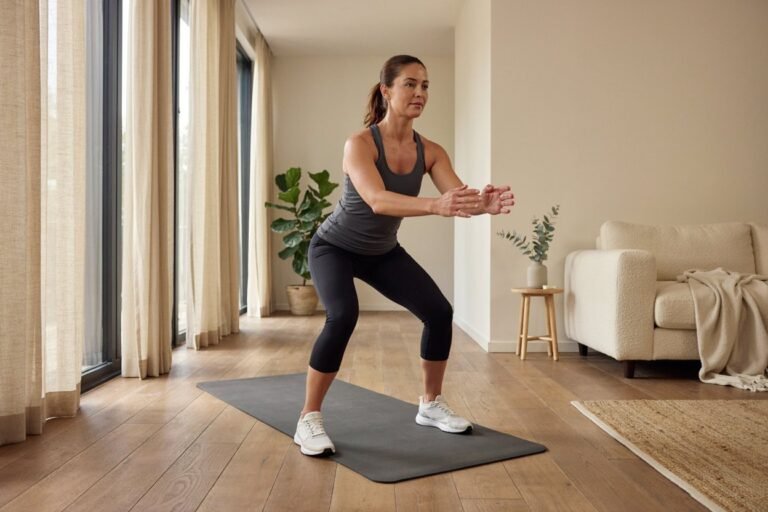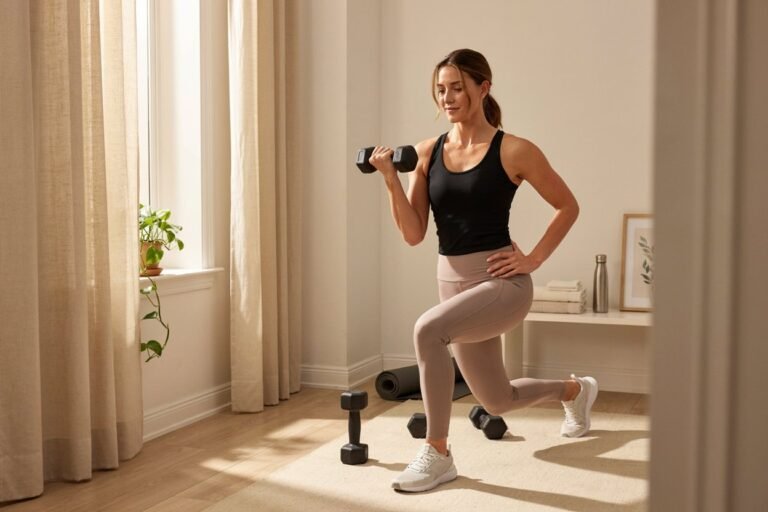
If you are looking for an easy leg workout for women over 40, you probably do not need another complicated fitness routine that leaves you exhausted for days.
I have found that simple exercises are often much easier to stick with, especially when life is already busy. Between work, family, errands, and everything else that fills the day, I prefer a leg workout that I can do at home without spending an hour at the gym.
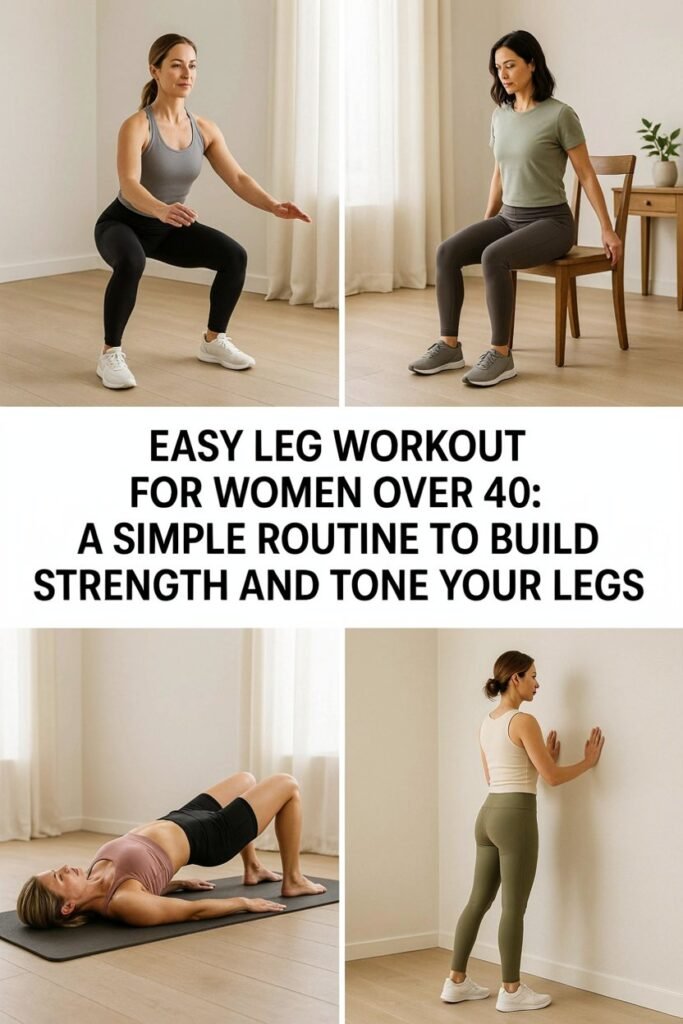
This routine focuses on building strength, improving balance, supporting everyday movement, and keeping the legs feeling strong and capable. You do not need to be extremely fit to begin, and you do not need heavy weights either.
I like starting with controlled bodyweight exercises and gradually making them more challenging as they become easier. In this guide, I will walk you through beginner friendly leg exercises, how to structure the workout, how often to train, and simple ways to progress without making exercise feel overwhelming.
Why I Like Simple Leg Workouts After 40
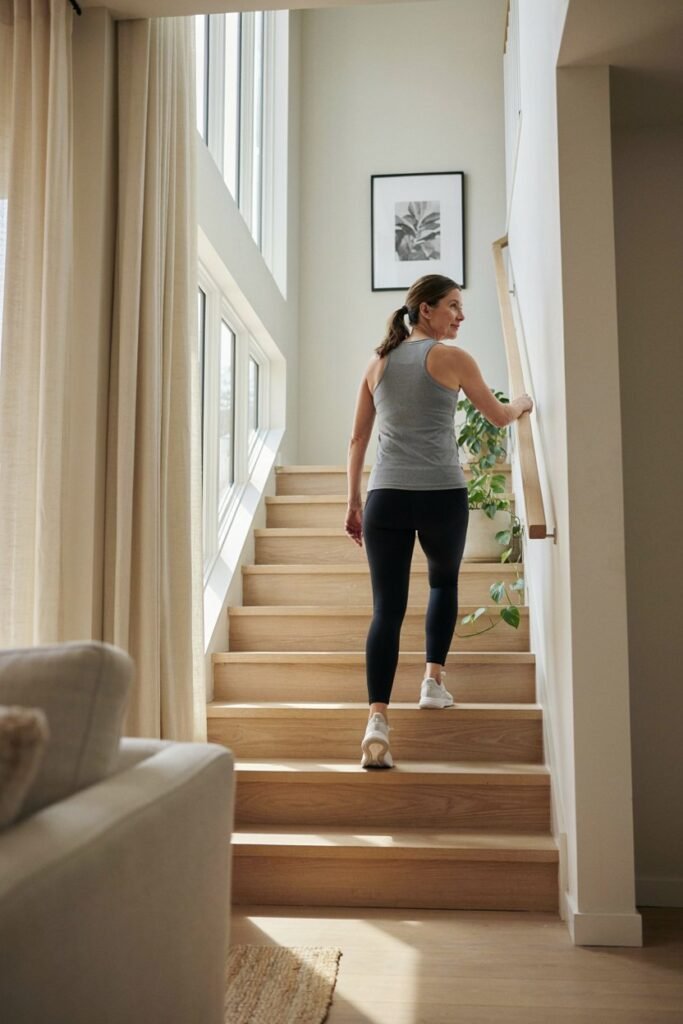
One thing I have learned with fitness is that the workout you can consistently complete is usually more useful than the perfect workout you never have time to do.
That is especially true with leg training.
Your legs are involved in so many ordinary activities. Walking around the house, climbing stairs, getting out of a chair, carrying groceries, playing with the kids, and even standing for long periods all require lower body strength.
I also like leg workouts because they do not have to involve complicated equipment. When I am short on time, I can put on comfortable clothes, clear a little space, and get started.
There is something satisfying about finishing a short workout and knowing that I have done something useful for my body.
For women over 40, I think the goal should be bigger than simply making the legs look toned. Building strength, maintaining muscle, improving stability, and feeling confident with everyday movement are all worthwhile reasons to train your legs.
What Makes This Workout Beginner Friendly?
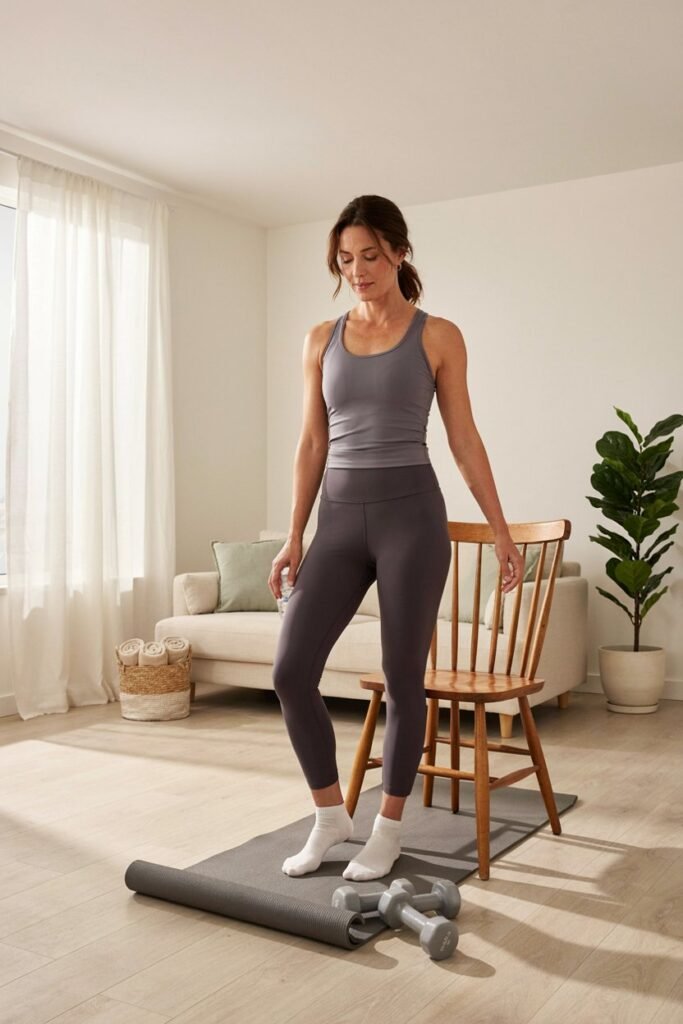
This routine is designed around simple movements that are easy to understand and modify.
You do not need to jump, run, or perform complicated exercises.
Most of the movements can be done slowly and with control.
If you are completely new to strength training, start with your own bodyweight. There is no reason to rush into heavy dumbbells just because someone online is using them.
I would much rather see you perform ten controlled repetitions than twenty rushed repetitions with poor form.
A sturdy chair can also be helpful.
I often recommend having one nearby when trying exercises that challenge your balance. It gives you something to hold onto if you need extra support and can make the workout feel much more comfortable.
What You Need Before You Start
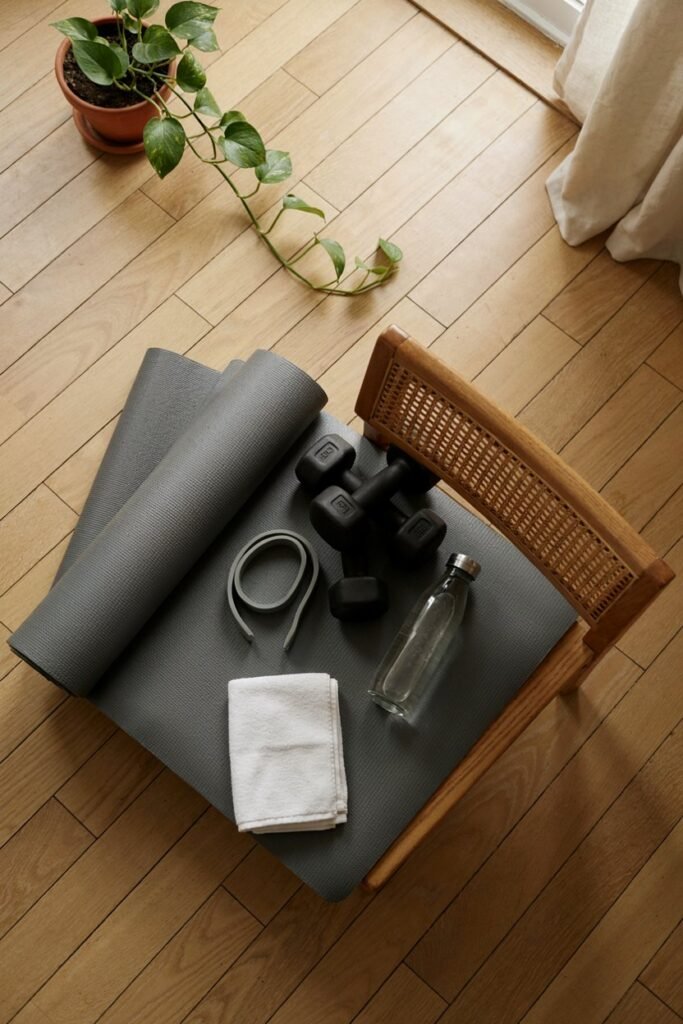
The nice thing about this workout is that you can keep your setup very simple.
You will need a little open floor space and a sturdy chair.
An exercise mat is optional, but I find one more comfortable for exercises such as glute bridges.
If you already have light dumbbells or resistance bands, you can use them later as you become stronger. However, I would not make equipment a requirement for getting started.
Before beginning, make sure your chair is stable and placed on a surface where it will not slide easily.
Wear comfortable clothing and supportive shoes if you prefer exercising with shoes on.
I also like keeping a bottle of water nearby because it is easy to get caught up in the workout and forget to drink.
Warm Up Before Your Leg Workout
Even though these exercises are relatively simple, I would not recommend going straight from sitting at your desk or on the couch into squats and lunges.
Give your body a few minutes to warm up.
A simple warmup can include walking around your room, marching gently in place, moving your arms, performing a few slow bodyweight squats, and gently moving your hips and ankles.
You do not need to turn the warmup into another workout.
The purpose is simply to get your body moving and prepare for the exercises ahead.
When I am doing a short workout at home, I find that even five minutes of gentle movement makes me feel more prepared than jumping straight into the first exercise.
1. Chair Squats
Chair squats are one of my favorite starting exercises because the chair gives you a clear target and can make regular squats feel less intimidating.
They work the thighs and glutes while also practicing a movement you use in everyday life.
How to Do Chair Squats
Stand in front of a sturdy chair with your feet approximately hip width apart.
Keep your chest lifted and your stomach gently engaged.
Push your hips backward as though you are about to sit down.
Bend your knees and lower yourself slowly toward the chair.
Lightly touch the chair with your hips, then press through your feet to stand back up.
Try not to drop heavily onto the chair.
The slower you perform the movement, the more control you will develop.
Beginner Tip
If you are nervous about balance, position the chair close enough that you can reach it easily.
You can also reduce how far you lower yourself.
There is no prize for getting as low as possible.
Start with a range of motion that feels comfortable and gradually work from there.
How Many Should You Do?
Start with 8 to 10 repetitions.
Rest for about 30 to 60 seconds before moving to the next exercise.
If that feels too easy after a few workouts, you can increase the repetitions or eventually hold light dumbbells.
2. Glute Bridges
Glute bridges are another exercise I like because they are simple, require no equipment, and can be done on the floor.
They primarily target the glutes while also involving the muscles around the back of the hips.
This is one of those exercises that can look almost too easy when you first see it, but performing it slowly makes a noticeable difference.
How to Do Glute Bridges
Lie on your back with your knees bent and your feet flat on the floor.
Keep your feet approximately hip width apart.
Place your arms beside your body.
Press your feet gently into the floor and lift your hips toward the ceiling.
Pause briefly at the top while squeezing your glutes.
Lower your hips slowly back toward the floor.
Try not to rush through the repetitions.
What I Focus On
When I do glute bridges, I concentrate on lifting through my hips rather than trying to push my body as high as possible.
You do not need to create a huge arch in your back.
A controlled lift followed by a slow lowering movement is enough.
If you feel the exercise mostly in your lower back, reduce the height of the lift and focus on engaging your glutes.
How Many Should You Do?
Start with 10 to 12 repetitions.
Once those become comfortable, you can add another set or eventually place a light resistance band around your thighs.
3. Standing Side Leg Raises
Standing side leg raises are particularly useful when you want to include a little balance work in your routine.
They target the muscles around the outside of the hips and can be performed without equipment.
How to Do Standing Side Leg Raises
Stand tall beside your sturdy chair or near a wall.
Place one hand on the chair for support if necessary.
Keep your standing leg slightly soft rather than locking your knee.
Slowly move your other leg out to the side.
Pause briefly, then bring the leg back toward the starting position.
Keep your upper body as still as possible.
The movement should come from the leg rather than from leaning your entire body to the opposite side.
Complete your repetitions and then switch sides.
Make It Easier
If balancing on one leg feels difficult, keep one hand firmly on the chair.
There is nothing wrong with using support.
As your balance improves, you may find that you need less assistance.
How Many Should You Do?
Aim for 10 repetitions on each side to start.
Keep the movement controlled rather than trying to lift your leg extremely high.
4. Calf Raises
Calf raises are easy to overlook, but I like including them because your calves play an important role in walking, climbing stairs, and maintaining stability.
They are also one of the easiest exercises to perform at home.
How to Do Calf Raises
Stand behind your sturdy chair and place your hands on it for balance.
Keep your feet approximately hip width apart.
Slowly lift your heels from the floor until you are standing on the balls of your feet.
Pause for a moment at the top.
Lower your heels slowly back down.
Try to avoid bouncing.
How Many Should You Do?
Start with 12 to 15 repetitions.
If you find these very easy after several sessions, you can increase the repetitions or eventually hold light weights.
5. Step Ups
Step ups are one of my favorite lower body exercises because they feel very practical. Walking up stairs is something we do in everyday life, so practicing a similar movement during a workout makes sense.
You do not need a tall platform. In fact, if you are new to exercise or have not trained your legs recently, I recommend starting with a low, sturdy step.
How to Do Step Ups
Stand facing a stable step or low platform.
Place your right foot firmly on the step.
Push through your right foot and bring your left foot up beside it.
Step back down carefully, leading with the same foot.
Repeat several times before switching sides, or alternate legs if that feels more natural.
Keep your chest lifted and avoid pushing yourself upward by swinging your arms or leaning heavily forward.
My Beginner Tip
Balance matters more than speed here.
When I am doing step ups, I would rather take my time and make sure my entire foot is secure on the step than rush through the repetitions.
If you are unsure about your balance, keep a wall or sturdy surface nearby for support.
How Many Should You Do?
Start with 8 repetitions on each leg.
As you become more comfortable, increase to 10 repetitions per side or use a slightly higher step.
There is no need to make the step extremely high to get the benefit of the exercise.
6. Reverse Lunges
Lunges can sometimes feel intimidating, especially if you have not done them for a while. That is why I prefer reverse lunges for beginners.
Instead of stepping forward, you step backward, which can make it easier to control the movement.
Reverse lunges work the thighs and glutes while also challenging your balance.
How to Do Reverse Lunges
Stand tall with your feet about hip width apart.
Take a comfortable step backward with your right foot.
Bend both knees and lower your body toward the floor.
Your front knee should stay aligned with your foot.
Push through your front foot to return to standing.
Repeat on the other side.
You do not have to lower your back knee all the way to the floor.
A smaller movement is perfectly fine when you are beginning.
Use a Chair for Support
If balance is an issue, place a sturdy chair beside you and hold onto it lightly.
This can make a huge difference.
I have found that exercises become much less frustrating when you stop worrying about falling and can concentrate on the actual movement.
How Many Should You Do?
Start with 6 to 8 repetitions on each side.
If regular reverse lunges feel difficult, reduce the depth of the movement or perform a smaller step backward.
Over time, you can gradually increase the range of motion.
7. Wall Sit
Wall sits are simple but surprisingly challenging.
They are also useful when you want to strengthen your thighs without performing lots of repetitions.
How to Do a Wall Sit
Stand with your back against a wall.
Walk your feet forward slightly.
Slowly bend your knees and slide your back down the wall.
Stop at a comfortable position.
You do not need to get your thighs completely parallel with the floor.
Hold the position while breathing normally.
Then slowly slide back up the wall.
Start Short
If you have never done wall sits before, do not worry about holding the position for a full minute.
Start with 15 to 20 seconds.
Rest and repeat if you feel comfortable.
As your legs become stronger, you can gradually work toward 30 seconds or more.
The goal is controlled progress rather than trying to prove how long you can suffer through the exercise.
8. Side to Side Squats
Side to side squats are a nice way to introduce a little more movement into your workout while working the legs and glutes.
They also encourage you to move in a direction that ordinary squats do not always include.
How to Do Side to Side Squats
Stand with your feet comfortably apart.
Shift your weight toward your right side and bend your right knee while keeping your left leg relatively straight.
Push through your right foot and return toward the center.
Repeat on the opposite side.
Keep the movement comfortable and controlled.
You do not need to squat deeply.
Make It Easier
If the movement feels awkward, reduce the distance you move from side to side.
You can also practice the movement beside a wall or sturdy chair until you feel more comfortable.
Start with 8 repetitions per side.
Why I Do Not Try to Make Every Workout Exhausting
There was a point when I thought a workout had to leave me completely exhausted to be worthwhile.
I do not look at exercise that way anymore.
A workout can be effective without leaving you unable to walk comfortably the next morning.
For women over 40, especially those who are getting back into exercise, recovery deserves just as much attention as the workout itself.
Your goal is to create something you can repeat.
If you train your legs so hard that you need several days before you want to exercise again, it becomes much harder to build a consistent routine.
I would rather finish a manageable workout and feel like I could do it again later in the week.
How Many Times a Week Should You Do This Workout?
For beginners, two leg workouts per week is a good starting point.
You can leave a few days between sessions to give your muscles time to recover.
For example, you might train your legs on Monday and Thursday.
On the days between your leg workouts, you can stay active with walking, gentle cycling, mobility exercises, or another type of activity you enjoy.
If you already have experience with strength training and recover well, you may eventually choose to train your lower body three times per week.
However, more workouts are not automatically better.
Consistency is what matters most.
What to Do on Your Non Workout Days
You do not have to spend your rest days sitting completely still.
One of my favorite options is simply walking.
A comfortable walk can be an easy way to stay active without turning every day into a demanding workout.
You could take a walk around your neighborhood, walk while running errands, or take a short evening walk after dinner.
Gentle movement can also help you avoid feeling stiff after spending a lot of time sitting.
The important thing is to choose activities that fit naturally into your routine.
How to Make This Leg Workout More Challenging
Eventually, your body will adapt.
Exercises that once felt difficult may begin to feel surprisingly easy.
That is actually a good thing.
It means you are becoming stronger.
When that happens, you do not need to completely replace the workout.
Instead, make small changes.
You can add a few repetitions.
You can perform another round.
You can slow down the lowering portion of a squat.
You can add light dumbbells.
You can use a resistance band.
You can increase the duration of a wall sit.
You can also choose a slightly more challenging version of an exercise.
I prefer making one change at a time.
That makes it easier to tell whether the new level is appropriate for you.
A Simple Two Round Workout
Once you are comfortable with the exercises in this guide, you can put them together into a simple routine.
Round One
Chair squats: 10 repetitions
Glute bridges: 12 repetitions
Standing side leg raises: 10 repetitions per side
Calf raises: 15 repetitions
Step ups: 8 repetitions per side
Reverse lunges: 6 repetitions per side
Wall sit: 20 seconds
Rest for about one minute.
Then repeat the round.
If two rounds feel like too much, start with one.
There is nothing wrong with building your endurance gradually.
Pay Attention to Your Form
One thing I remind myself during leg workouts is that completing the repetition is not the only goal.
How you perform the repetition matters.
For squats, keep your chest lifted and move with control.
For lunges, avoid rushing.
For step ups, make sure your foot is firmly planted.
For glute bridges, focus on using your glutes rather than forcing your hips excessively high.
For standing exercises, use support if you need it.
Small adjustments can make exercises feel completely different.
When you slow down, you also become more aware of what your body is doing.
What If You Have Not Exercised in a Long Time?
Do not feel like you need to complete the entire workout immediately.
This is something I think is easy to forget when looking at fitness content online.
You may see someone completing ten exercises and assume you need to do exactly the same thing.
You do not.
Start with three or four exercises.
Do one round.
See how your body responds.
Then gradually add more.
If you have a medical condition, recent injury, significant joint pain, or concerns about starting exercise, speak with your healthcare professional before beginning a new workout routine.
The best routine is one that fits your current fitness level and gives you room to improve.
The Goal Is Strength You Can Actually Use
For me, the most rewarding part of leg training is not simply how the legs look.
It is noticing that everyday movements start to feel easier.
Getting out of a chair feels more natural.
Stairs feel less intimidating.
Carrying bags does not feel quite as demanding.
Walking for longer becomes more comfortable.
Those little improvements are easy to overlook because they happen gradually.
But they are exactly the type of progress that makes strength training worth continuing.
Common Mistakes to Avoid With Leg Workouts After 40
A good leg workout is not only about choosing the right exercises. How you approach the workout matters too.
I have made some of these mistakes myself, especially when trying to make a short workout feel more productive. The problem is that pushing harder is not always the same thing as training better.
Here are some of the mistakes I would avoid.
Doing Too Much Too Soon
It can be tempting to start with several rounds because you feel motivated.
The problem usually comes later when your legs are extremely sore and you do not want to exercise again.
Start with less than you think you can handle.
You can always add more.
Rushing Through Repetitions
Fast repetitions can make a workout feel easier because you are not spending as much time under control.
Slow the movement down.
For exercises such as squats and glute bridges, pay attention to both the lowering and lifting portions.
Good form is more important than racing through a certain number of repetitions.
Ignoring Balance
You do not need to prove that you can perform every standing exercise without support.
If you need a chair, wall, or other stable surface, use it.
Balance is something you can work on gradually.
There is no benefit in making an exercise unnecessarily difficult and worrying about losing your footing.
Only Training the Front of Your Legs
Squats and lunges are great exercises, but your lower body involves much more than your thighs.
That is why I like including glute bridges, side leg raises, calf raises, and other movements in the routine.
A balanced workout gives different muscle groups a reason to work.
Expecting Results Overnight
This is probably one of the biggest sources of frustration with fitness.
You may complete a workout and feel stronger immediately, but visible changes take consistency.
Give yourself time.
Instead of judging your progress only by how your legs look, pay attention to other signs.
Are you completing more repetitions?
Are the exercises becoming easier?
Can you use slightly heavier weights?
Do stairs feel easier?
Can you walk longer without feeling as tired?
Those changes matter.
Can You Tone Your Legs With This Workout?
Yes, strength training can help build and maintain muscle, which can contribute to a firmer and more defined appearance.
However, I would not promise that a particular leg exercise will remove fat from one specific area.
Our bodies do not work that way.
If your goal is to change your overall body composition, your workout routine works best alongside regular movement, adequate nutrition, sleep, and other healthy habits.
For me, focusing on getting stronger makes the process much less frustrating than constantly checking whether a specific part of my body has changed.
How Walking Can Complement Your Leg Workouts
You do not have to spend every day doing strength workouts.
Walking is one of the easiest activities to add to your routine.
I like walking because it does not require much preparation. You can take a short walk around the neighborhood, walk while doing errands, or simply make an effort to move more throughout the day.
If you are currently inactive, start with a comfortable amount.
You might begin with a 10 minute walk and gradually increase the duration.
The goal is not to turn every walk into a race.
Regular movement can fit alongside your strength training and help you build a more active lifestyle without making your schedule feel overwhelming.
A Simple Weekly Plan for Women Over 40
If you want something easy to follow, you can use this basic weekly structure.
Monday
Leg workout
Tuesday
Walking or gentle movement
Wednesday
Rest or mobility work
Thursday
Leg workout
Friday
Walking or another enjoyable activity
Saturday
Optional light full body workout or longer walk
Sunday
Rest
You can adjust this schedule around your own life.
If Monday and Thursday are not convenient, choose two other days.
The best schedule is the one you can realistically follow.
When Should You Increase the Difficulty?
You will know it is time to progress when your current workout starts feeling noticeably easier.
For example, if you can complete your chair squats with good form and still feel like you could comfortably perform several more repetitions, you may be ready for a small increase in difficulty.
Do not change everything at once.
You could add a few repetitions.
Or add a second round.
Or introduce light dumbbells.
Or use a resistance band.
Or slow down the movement.
Small changes can create enough additional challenge without completely changing the workout.
What I Would Keep in My Home Workout Space
You do not need to turn a room in your house into a gym.
For this type of workout, I would keep things simple.
A sturdy chair is probably the most useful item because it can help with squats, balance, and modifications.
A comfortable exercise mat is useful for floor exercises such as glute bridges.
Light dumbbells can be added once bodyweight exercises become easy.
A resistance band is another inexpensive option for adding challenge to certain movements.
That is enough to create plenty of variety.
How to Stay Consistent When Life Gets Busy
This is where I think many workout plans fail.
The routine looks great on paper, but it requires so much time that it becomes difficult to maintain.
I prefer having a short version of my workout available for busy days.
If I only have 15 minutes, I can choose four exercises and complete one or two rounds.
That is still movement.
I do not believe every workout has to be perfect.
There will be days when you have plenty of energy and time.
There will also be days when you are dealing with work, family, errands, cooking, cleaning, or simply feeling tired.
Having a flexible routine makes it much easier to keep going.
My Favorite Short Version of This Workout
If you are having one of those busy days, try this simple combination.
Chair squats: 10 repetitions
Glute bridges: 12 repetitions
Standing side leg raises: 10 repetitions per side
Calf raises: 15 repetitions
Rest for about one minute and repeat if you have time.
That is enough to give your legs some focused work without turning the workout into a long session.
Frequently Asked Questions
Is This Leg Workout Suitable for Beginners Over 40?
Yes. The exercises can be modified to match your current fitness level.
Start with bodyweight, use a chair for support when needed, and keep the repetitions manageable.
You can increase the difficulty as you become stronger.
How Often Should I Do This Leg Workout?
For most beginners, two strength sessions per week is a practical starting point.
Give yourself recovery time between sessions and adjust the frequency based on how your body responds.
Do I Need Dumbbells?
No.
You can begin with bodyweight exercises.
Once the workout becomes easier, light dumbbells or resistance bands can provide additional resistance.
Can I Do This Workout at Home?
Absolutely.
That is one of the reasons I like this routine.
You need very little space and basic household equipment can provide enough support for many of the exercises.
How Long Should the Workout Take?
A complete session may take around 20 to 30 minutes depending on how many exercises and rounds you perform.
If you are short on time, even a 10 to 15 minute version can be useful.
Should I Exercise Every Day?
You do not need to perform this leg workout every day.
Your muscles need time to recover.
On other days, you can walk, stretch, work on mobility, or choose another activity you enjoy.
What If Squats Are Difficult?
Start with chair squats.
The chair gives you a target and allows you to control how low you go.
You can also reduce the depth of the squat and gradually increase it as you become more comfortable.
What If I Have Poor Balance?
Use a sturdy chair or wall for support during standing exercises.
Balance can improve with practice, but there is no reason to remove support before you are ready.
Final Thoughts
An effective leg workout does not have to be complicated, exhausting, or filled with expensive equipment.
For women over 40, I think there is a lot of value in keeping strength training simple enough that you actually want to come back to it.
Start with the exercises that feel comfortable.
Learn the movements.
Build consistency.
Then gradually increase the challenge as your strength improves.
What I like most about this type of workout is that the goal goes beyond appearance. Stronger legs can make everyday activities feel more manageable, from climbing stairs to getting up from a chair and carrying things around the house.
You do not have to completely change your lifestyle to become stronger.
Start with a few exercises, give yourself time to improve, and remember that small workouts still count.
The routine that you can consistently fit into your life will always be more valuable than the perfect workout that you never have time to do.